
Applications of AI and IoT in Rare Earth and Critical Mineral Operations
Rare earth and critical minerals have become essential raw materials for permanent magnets, electric vehicles, offshore wind turbines, semiconductor manufacturing, aerospace systems, defense technologies, robotics, telecommunications, energy storage, advanced electronics, and next-generation industrial manufacturing. Production requires highly coordinated activities spanning exploration support, drilling, blasting, loading, hauling, crushing, grinding, beneficiation, flotation, magnetic separation, hydrometallurgical processing, solvent extraction, ion exchange, precipitation, calcination, rare earth oxide production, warehouse management, and export logistics.
AI and IoT combines AI with connected identification technologies, industrial communications, enterprise software, and Edge AI to improve operational visibility throughout these activities. Unlike general industrial monitoring systems, AIoT solutions for rare earth operations prioritize identification, authentication, location awareness, inventory accountability, and movement analytics for personnel, contractors, vehicles, mobile equipment, mineral inventories, work-in-progress materials, and finished products.
Using RFID, BLE, UWB, GPS, LoRaWAN, Private LTE, Industrial Wi-Fi, and secure enterprise software, mining organizations can optimize workforce deployment, improve fleet utilization, strengthen regulatory compliance, reduce inventory discrepancies, enhance production planning, and maintain trusted chain of custody records from run-of-mine (ROM) ore through separated rare earth oxides and refined critical mineral products.
AI + IoT Operational Workflow Across the Rare Earth and Critical Mineral Value Chain
This enterprise engineering illustration shows how AI and IoT technologies connect every stage of the rare earth and critical mineral value chain, from mining and mineral processing to refining, warehousing, and export logistics. It demonstrates how RFID, BLE, UWB, GPS, industrial communications, edge computing, and enterprise software integrate workforce, equipment, inventory, and production data into centralized AI analytics and operational dashboards. The visual emphasizes end-to-end operational visibility, digital chain of custody, inventory accuracy, regulatory compliance, and data-driven decision-making across the entire mining lifecycle.
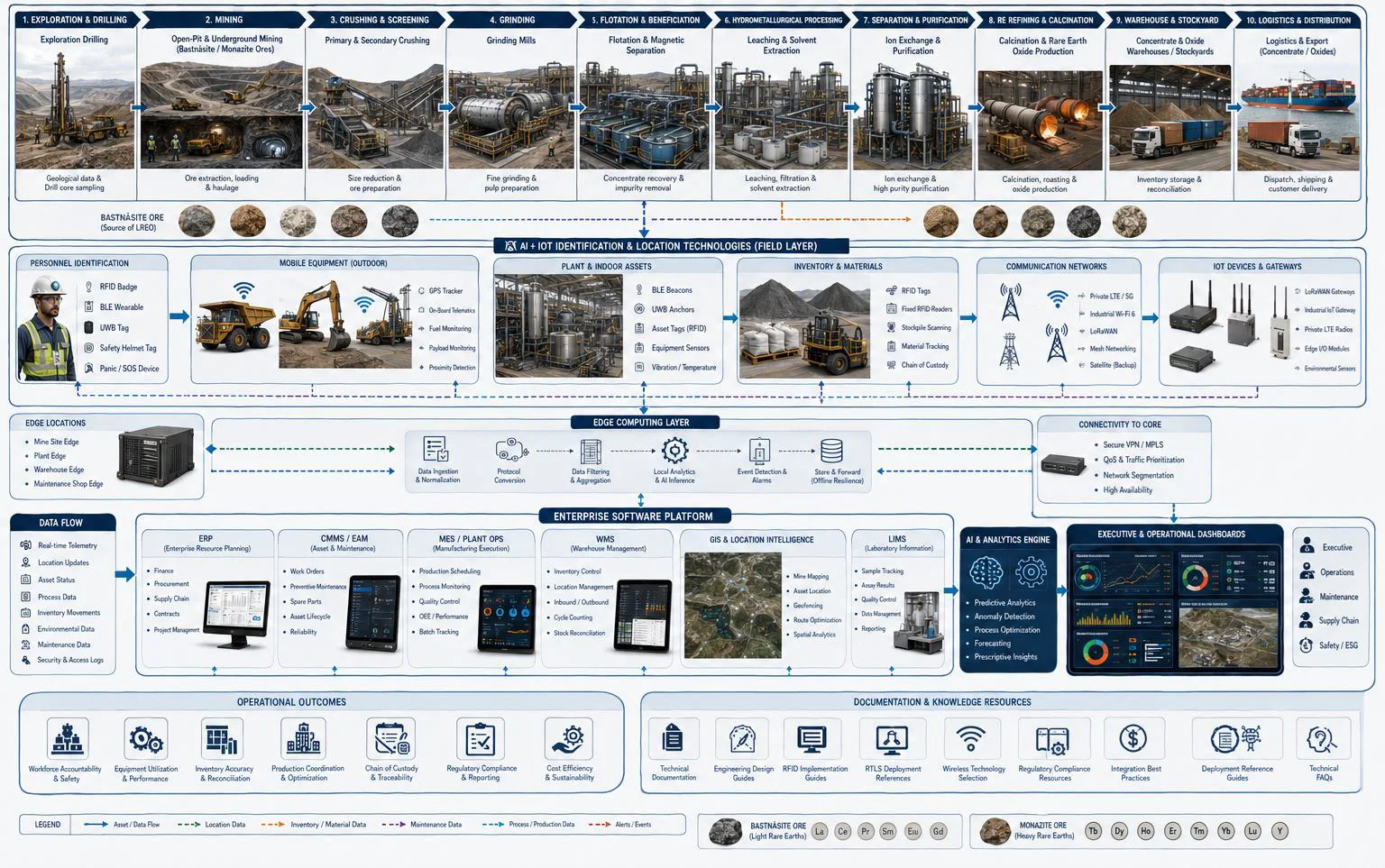
AIoT Across the Rare Earth and Critical Mineral Value Chain
Rare earth mining differs significantly from conventional metal mining because the production chain involves specialized mineral beneficiation and chemical separation processes designed to recover valuable rare earth elements such as neodymium (Nd), praseodymium (Pr), dysprosium (Dy), terbium (Tb), cerium (Ce), lanthanum (La), yttrium (Y), and scandium (Sc). Deposits may include bastnäsite, monazite, xenotime, ionic clay deposits, or carbonatite-hosted mineralization, each requiring different extraction and processing strategies.
Operational activities typically include:
- Exploration support and drilling.
- Open-pit or underground mining.
- Ore hauling and primary crushing.
- Comminution through crushing and grinding circuits.
- Beneficiation using flotation, gravity separation, or magnetic separation.
- Hydrometallurgical leaching.
- Solvent extraction (SX) using mixer-settler circuits.
- Ion exchange purification.
- Rare earth precipitation and calcination.
- Rare earth oxide (REO) production.
- Mixed rare earth carbonate (MREC) handling.
- Product packaging and warehousing.
- Domestic and international logistics.
Every operational stage depends on accurate identification and location of personnel, equipment, mineral inventories, production batches, and transportation assets. AI and IoT enables continuous operational awareness by integrating intelligent software with industrial identification technologies. Rather than relying solely on manual documentation, AI systems analyze workforce movement, equipment utilization, inventory changes, production flow, and logistics activities to improve operational efficiency and support informed decision-making.
Frequently deployed wireless technologies include:
- RFID for personnel identification, asset tracking, warehouse management, inventory reconciliation, and chain of custody verification.
- BLE for indoor positioning and proximity-based workforce accountability.
- UWB for centimeter-level positioning of personnel and equipment inside processing plants and maintenance workshops.
- GPS for surface fleet management and mobile equipment tracking.
- LoRaWAN for long-range connectivity across expansive mining leases and stockyard operations.
- Private LTE for secure communications throughout large mining sites and underground operations.
- Industrial Wi-Fi for processing plants, warehouse facilities, maintenance workshops, laboratories, and administrative buildings.
Operational records generated by these technologies integrate with enterprise software including Enterprise Resource Planning (ERP), Computerized Maintenance Management Systems (CMMS), Manufacturing Execution Systems (MES), Warehouse Management Systems (WMS), Geographic Information Systems (GIS), Laboratory Information Management Systems (LIMS), Mine Planning Software, Production Reporting Systems, and Enterprise Analytics Software. This integration enables production planners, mine managers, maintenance supervisors, warehouse personnel, logistics coordinators, and executive leadership to make operational decisions using trusted, continuously updated information.
Rare Earth Open-Pit Mining Applications
Open-pit rare earth mining operations encompass extensive production areas containing drill-and-blast benches, loading zones, haul roads, waste dumps, ore stockpiles, crushing stations, explosive magazines, maintenance workshops, fueling stations, weighbridges, and dispatch centers. Maintaining accurate operational visibility across these geographically dispersed assets is essential for maximizing production efficiency while protecting personnel and equipment.
AI and IoT improves operational coordination by combining personnel identification, equipment location, controlled access, inventory accountability, and production movement records into a unified enterprise software environment. Operational managers obtain continuously updated information that supports production scheduling, workforce deployment, dispatch optimization, maintenance planning, and regulatory compliance.
Critical Mineral Underground Mining Applications
Underground rare earth and critical mineral mining presents significantly different operational challenges from surface mining. Personnel, contractors, mobile equipment, production materials, and maintenance resources operate across multiple production levels connected by declines, shafts, drifts, crosscuts, stopes, ore passes, ventilation raises, refuge chambers, pump stations, electrical substations, conveyor galleries, underground workshops, and loading pockets. Limited visibility, complex traffic patterns, and restricted communication pathways require highly reliable identification and location systems to maintain operational awareness.
AI and IoT solutions emphasize accurate identification and real-time location of people, mobile equipment, production assets, and material movement. By combining RFID, BLE, UWB, Private LTE, Industrial Wi-Fi, and Edge AI, underground mining organizations can improve workforce accountability, coordinate production activities, optimize fleet utilization, and strengthen emergency preparedness while reducing dependence on manual reporting.
Rare Earth Separation Plant Applications
Following mining and beneficiation, rare earth concentrates enter specialized processing facilities where valuable rare earth elements are separated through hydrometallurgical processing, solvent extraction, ion exchange, precipitation, filtration, drying, calcination, and packaging. These facilities contain hundreds of production assets operating simultaneously across interconnected process stages.
Maintaining accurate identification of equipment, work-in-progress materials, production batches, warehouse inventories, and maintenance activities is essential for production continuity, product quality, and operational efficiency.
AI + IoT Underground Personnel and Equipment Location System for Rare Earth Mining Operations
This engineering illustration demonstrates how AI and IoT technologies deliver continuous visibility of personnel, mobile equipment, and critical underground infrastructure throughout a rare earth mining operation. It integrates RFID, BLE, UWB, Private LTE, Industrial Wi-Fi, edge computing, enterprise software, and AI analytics to support workforce safety, equipment utilization, production monitoring, regulatory compliance, and real-time operational decision-making.
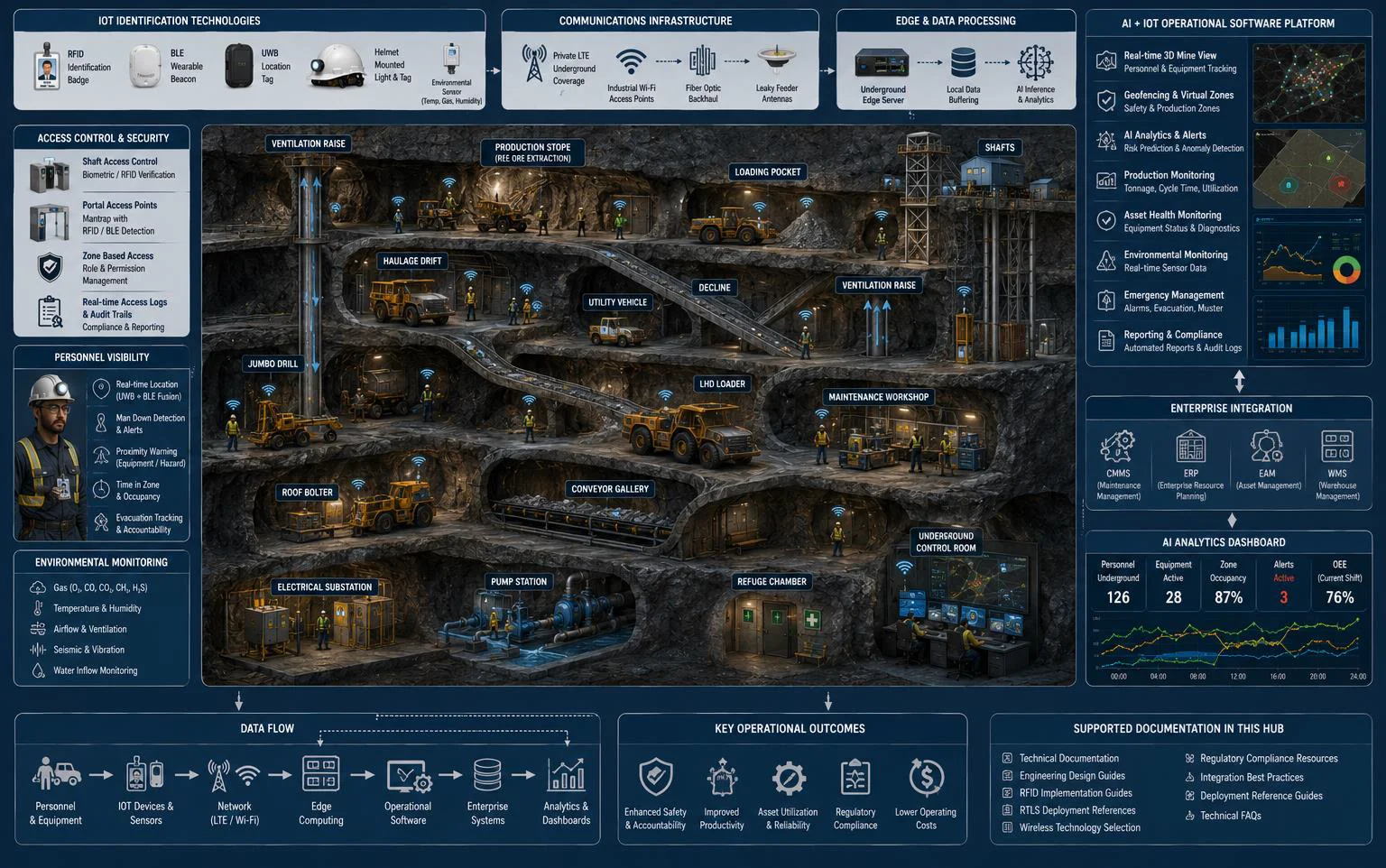
Critical Mineral Refining Facility Applications
Critical mineral refining facilities transform intermediate rare earth materials into high-purity products supporting permanent magnet manufacturing, electric vehicles, semiconductor fabrication, aerospace systems, defense technologies, renewable energy infrastructure, medical devices, robotics, and advanced industrial manufacturing.
Refining operations require complete operational documentation because product quality, customer specifications, regulatory requirements, and international supply chain transparency depend upon verified production records.
Strategic Mineral Stockyard Applications
Strategic mineral stockyards function as operational buffers between mining, mineral processing, refining, warehousing, and outbound logistics. These facilities may contain run-of-mine (ROM) ore, crushed ore, beneficiated concentrates, mixed rare earth carbonate (MREC), rare earth oxides (REO), packaged products, spare parts, maintenance materials, export containers, and customer-specific inventory allocations. Since stockyards often span large outdoor areas with constantly changing inventory locations, accurate identification and location management are essential for maintaining production continuity.
Rare Earth Tailings Storage Facility Applications
Tailings storage facilities (TSFs) remain operational throughout the life of a mining project and require routine inspections, maintenance activities, contractor access, mobile equipment coordination, and regulatory documentation. Personnel regularly travel between embankments, decant systems, return water infrastructure, pumping stations, maintenance areas, and controlled access points.
AI and IoT solutions focused on identification and location improve accountability without relying on generalized sensing technologies.
- Personnel check-in verification.
- Authorized access management.
- Contractor credential validation.
- Mobile equipment identification.
- Inspection team accountability.
- Maintenance vehicle tracking.
- Emergency evacuation reporting.
- Historical workforce documentation.
Historical identification records also support incident investigations, regulatory inspections, operational audits, and long-term infrastructure management.
AIoT Integration Across Rare Earth and Critical Mineral Operations
Large mining organizations frequently operate multiple open-pit mines, underground mines, beneficiation plants, hydrometallurgical facilities, solvent extraction plants, refining facilities, laboratories, maintenance workshops, warehouses, stockyards, rail terminals, and export logistics centers. Operational information generated throughout these locations becomes substantially more valuable when synchronized through enterprise software.
Engineering Best Practices for AI and IoT Deployment
Successful AI and IoT implementation in rare earth and critical mineral operations requires a structured engineering methodology that aligns identification technologies with operational workflows, production objectives, and enterprise information systems.
Recommended engineering practices include:
- Conduct comprehensive operational site assessments before selecting RFID, BLE, UWB, GPS, LoRaWAN, Private LTE, or Industrial Wi-Fi technologies.
- Define standardized identification policies for personnel, contractors, mobile equipment, fixed assets, inventory, and production batches.
- Establish consistent asset naming conventions and digital identification standards across all operating sites.
- Validate wireless coverage throughout open-pit mines, underground workings, beneficiation facilities, refining plants, warehouses, stockyards, and logistics corridors.
- Integrate AI and IoT software with ERP, CMMS, MES, WMS, GIS, LIMS, Mine Planning Software, and Fleet Management Software where appropriate.
- Implement role-based access control and cybersecurity policies aligned with corporate governance requirements.
- Perform phased pilot deployments before enterprise-wide implementation.
- Train operations personnel, maintenance technicians, warehouse teams, supervisors, and administrators using standardized operational procedures.
- Conduct routine audits of identification accuracy, inventory reconciliation, workforce accountability, equipment utilization, and chain of custody documentation.
- Review operational analytics regularly to support continuous improvement and long-term optimization.
Industry Experience and Technical Credibility
RareMetal AI was created within Aperture Venture Studio with support from GAO, building on more than two decades of industrial IoT experience across complex operational environments. This experience reflects thousands of successfully delivered IoT projects and extensive practical knowledge gained from serving organizations throughout the Mining & Resources Industry, including rare earth and critical mineral operations.
Significant investments in research and development, rigorous quality assurance processes, and experienced engineering teams support reliable AI and IoT deployments tailored to demanding mining environments. The organization is led by Ph.D. professionals from leading universities and is supported by strategic technology partners and subject matter experts specializing in industrial automation, enterprise software integration, wireless communications, and AI-driven operational analytics.
Business and Operational Value of AI and IoT for Rare Earth & Critical Mineral Operations
Rare earth and critical mineral operations are becoming increasingly strategic because they supply essential materials for permanent magnet production, electric vehicles, wind turbines, battery energy storage systems, semiconductor fabrication, aerospace components, defense technologies, robotics, telecommunications infrastructure, advanced medical equipment, and precision industrial manufacturing. As global demand for rare earth oxides (REO), mixed rare earth carbonate (MREC), neodymium-praseodymium (NdPr), dysprosium (Dy), terbium (Tb), yttrium (Y), scandium (Sc), cerium (Ce), and lanthanum (La) continues to increase, mining organizations must improve operational efficiency while maintaining workforce safety, regulatory compliance, and supply chain transparency.
Unlike traditional manual reporting processes, AI and IoT provides continuously updated operational records that help organizations:
- Improve workforce accountability & Strengthen contractor management.
- Verify controlled area access.
- Optimize mobile equipment utilization & Improve dispatch coordination.
- Reduce equipment search time & Improve maintenance planning.
- Increase warehouse efficiency.
- Improve stockpile reconciliation & Strengthen inventory accuracy.
- Improve production scheduling.
- Verify work-in-progress movement.
- Maintain chain of custody records & Support ESG documentation.
- Improve responsible sourcing transparency.
- Simplify regulatory reporting & Improve executive decision-making.
Typical AI and IoT Identification Technologies Used Throughout Rare Earth Operations
Successful AI and IoT deployments rarely depend on a single wireless technology. Most enterprise mining organizations deploy multiple complementary identification and communication technologies, selecting each according to operational requirements, coverage area, positioning accuracy, infrastructure availability, and production workflows.
| Technology | Specific Applications in Rare Earth & Critical Mineral Operations |
|---|---|
| RFID | Personnel access control for radiological and chemical processing areas; reagent and chemical drum identification; rare earth concentrate bag and container tracking; ore sample chain of custody; maintenance tool tracking; warehouse inventory of critical spares; export shipment verification; laboratory sample identification. |
| BLE (Bluetooth Low Energy) | Real-time personnel location in solvent extraction plants, cracking facilities, and refineries; proximity alerts around acid plants and high-temperature kilns; lone-worker monitoring; contractor accountability; indoor asset tracking for portable analyzers, pumps, and maintenance equipment. |
| UWB (Ultra-Wideband) | Centimeter-level positioning of personnel in solvent extraction halls; automated tracking of AGVs and forklifts in rare earth warehouses; precise movement monitoring of high-value NdPr oxide containers; collision avoidance in maintenance workshops; laboratory asset tracking. |
| GPS / GNSS | Open-pit rare earth mine fleet management; drill rig positioning; ore and waste haulage optimization; ore stockpile mapping; exploration vehicle tracking; tailings dam inspection routes; logistics tracking from mine to cracking or separation facilities. |
| LoRaWAN | Environmental monitoring across remote mining leases; tailings storage facility instrumentation; groundwater and borehole monitoring; radiation sensor networks around waste storage; remote stockpile monitoring; distributed equipment condition monitoring. |
| Private LTE / Private 5G | Reliable communications across integrated mine-to-processing operations; autonomous or semi-autonomous haul trucks; mobile workforce connectivity; real-time SCADA access in remote process areas; video surveillance for critical infrastructure; emergency response coordination. |
| Industrial Wi-Fi | Connectivity in beneficiation plants, flotation circuits, hydrometallurgical processing, cracking plants, solvent extraction facilities, precipitation, calcination, and refining operations; laboratory instrumentation; handheld operator terminals; digital maintenance systems; warehouse scanners. |
| Edge Computing | Local execution of production workflows; RFID and sensor event processing; real-time ore tracking from mine to refinery; AI-based equipment health monitoring; low-latency safety analytics; local historian and operational dashboards; process optimization during network outages. |
Contact RareMetal AI
Rare earth and critical mineral operations require identification and location solutions that align with production objectives, workforce safety programs, inventory control procedures, maintenance strategies, cybersecurity requirements, and regulatory obligations.
RareMetal AI delivers enterprise AI and IoT software and engineering expertise that helps mining organizations improve operational visibility across personnel, contractors, mobile equipment, inventories, work-in-progress materials, production activities, and logistics operations. Whether supporting a greenfield rare earth project, expanding an existing beneficiation facility, modernizing a solvent extraction plant, or integrating enterprise software across multiple mining locations, our engineering teams work closely with customers to develop practical solutions aligned with operational requirements.
Advancing Rare Earth & Critical Mineral Operations with Enterprise AI and IoT
AI and IoT is reshaping rare earth and critical mineral operations by delivering reliable identification, precise location awareness, enterprise software integration, and data-driven operational decision support across the complete mining value chain. From open-pit extraction and underground mining to beneficiation, hydrometallurgical processing, solvent extraction, refining, warehousing, stockyard management, and export logistics, identification and location technologies help organizations improve workforce accountability, optimize equipment utilization, strengthen inventory reconciliation, and maintain trusted chain of custody records.
By integrating RFID, BLE, UWB, GPS, LoRaWAN, Private LTE, Industrial Wi-Fi, Edge AI, and enterprise software with existing operational workflows, mining organizations can increase operational efficiency while supporting safety, regulatory compliance, responsible sourcing, and long-term supply chain resilience. RareMetal AI provides the technical expertise, enterprise software capabilities, and implementation experience to help rare earth and critical mineral producers deploy scalable AI and IoT solutions that deliver measurable operational value across the entire Mining & Resources Industry.
Contact Us