
Enterprise AI and IoT Software for Rare Earth & Critical Mineral Mining, Processing, Separation, and Refining Facilities
Rare earth and critical minerals are fundamental to electric vehicles, permanent magnets, wind turbines, aerospace systems, advanced electronics, semiconductors, defense technologies, battery manufacturing, and numerous strategic industrial applications. Operations extracting and processing minerals such as neodymium, praseodymium, dysprosium, terbium, yttrium, scandium, lanthanum, cerium, lithium, cobalt, graphite, nickel, and other strategic resources require accurate operational visibility throughout extraction, mineral processing, refining, storage, and distribution.
Unlike conventional bulk mining operations, rare earth production involves multiple highly specialized processing stages including ore characterization, comminution, crushing, grinding, classification, flotation, magnetic separation, gravity concentration, hydrometallurgical extraction, acid or alkaline leaching, solvent extraction, ion exchange, precipitation, calcination, oxide production, packaging, warehousing, and shipment. Materials frequently transition through numerous controlled production stages while maintaining documented provenance, operational accountability, inventory integrity, and regulatory compliance.
Enterprise AI and IoT software serves as the operational coordination layer that manages identification and location events generated by RFID, BLE, UWB Real-Time Location Systems (RTLS), GPS, LoRaWAN, and cellular communication technologies. Rather than simply displaying asset locations, the software validates operational workflows, synchronizes identification records with enterprise applications, automates operational events, and provides decision-support information that improves safety, productivity, and operational transparency.
The result is enhanced workforce accountability, improved equipment utilization, more accurate ore and concentrate inventory management, stronger chain of custody documentation, optimized warehouse operations, and better visibility across the entire rare earth and critical mineral value chain.
Personnel Tracking Software
Personnel accountability is one of the highest operational priorities within rare earth and critical mineral operations. Mining organizations must accurately determine the location of miners, drilling crews, geologists, metallurgists, process operators, maintenance technicians, laboratory personnel, contractors, visitors, emergency responders, and supervisors across geographically dispersed extraction and processing facilities.
AI and IoT personnel tracking software continuously processes identification events from RFID credentials, BLE badges, UWB RTLS location tags, GPS-enabled mobile devices, and approved cellular communication systems to maintain operational awareness across surface mines, underground workings, processing plants, and refining facilities.
Personnel visibility supports operations across:
- Open-pit mining benches
- Underground production levels
- Decline ramps
- Crusher stations
- Grinding plants
- Concentrator facilities
- Flotation circuits
- Solvent extraction plants
- Ion exchange facilities
- Rare earth separation plants
- Oxide production buildings
- Chemical storage facilities
- Maintenance workshops
- Warehouse operations
- Tailings facilities
- Security checkpoints
- Administration buildings
- Remote exploration camps
Continuous workforce visibility reduces dependence on manual attendance procedures while helping supervisors coordinate production activities, contractor movements, maintenance scheduling, emergency preparedness, and operational compliance.
Typical software capabilities include:
- Real-time workforce location visualization
- Shift attendance verification
- Automated worker check-in and check-out
- Contractor accountability
- Restricted zone breach notifications
- Emergency muster reporting
- Lone worker protection
- Workforce deployment analysis
- Historical movement reporting
- Operational utilization analytics
- Geofenced work zone verification
- Workforce evacuation reporting
Historical movement records can also be analyzed by AI models to identify recurring congestion points, optimize travel routes between operational areas, improve workforce deployment, and support continuous operational improvement initiatives.
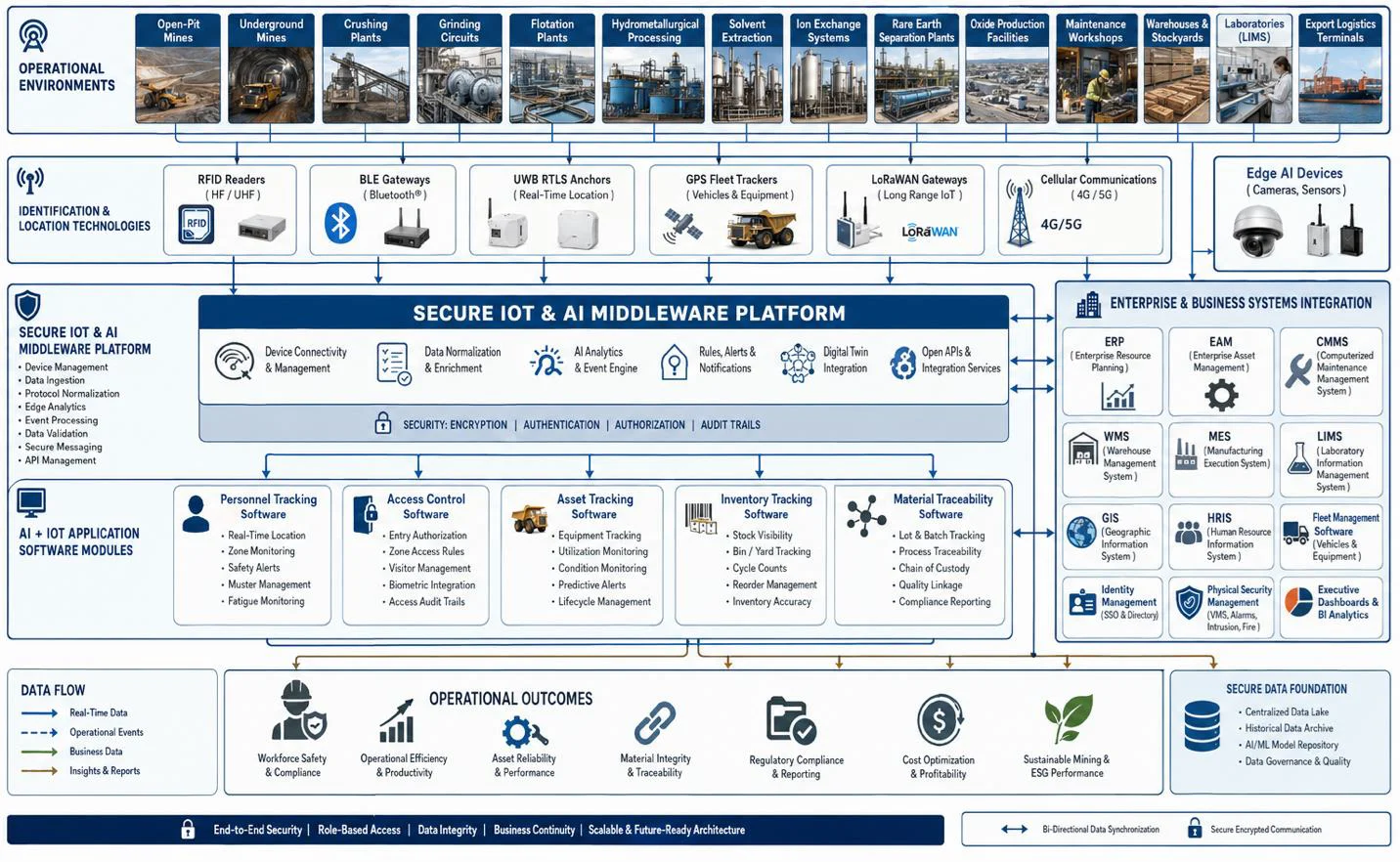
Enterprise AI + IoT Software Integration Architecture for Rare Earth and Critical Mineral Mining Operations
This enterprise block diagram illustrates how AI-enabled IoT software integrates RFID, BLE, UWB RTLS, GPS, LoRaWAN, and cellular communication technologies with secure middleware and operational software across rare earth and critical mineral mining. It demonstrates seamless connectivity between mining, mineral processing, maintenance, warehousing, laboratories, and export logistics while synchronizing data with ERP, EAM, CMMS, WMS, MES, LIMS, GIS, HRIS, fleet management, identity management, physical security, and executive dashboards. The visual emphasizes secure, real-time operational intelligence, end-to-end material traceability, workforce safety, asset visibility, regulatory compliance, and enterprise-wide decision support.
Access Control Software
Rare earth and critical mineral facilities contain numerous operational areas requiring controlled access because they house strategic mineral inventories, hazardous processing chemicals, proprietary separation processes, electrical infrastructure, laboratory operations, explosives, or high-value production equipment.
AI and IoT access control software authenticates personnel credentials before permitting entry into designated operational zones while maintaining complete digital records of every authorized and unauthorized access event.
Credential validation may include:
- RFID employee credentials
- BLE identification badges
- Mobile digital credentials
- Visitor registration
- Contractor authorization
- Multi-factor authentication
- Time-based access schedules
- Shift-specific permissions
- Role-based authorization
- Temporary work permits
- Contractor competency verification
- Certification validation
Access events are automatically recorded, creating comprehensive audit trails that simplify regulatory reporting, internal investigations, operational reviews, and security audits.
Asset Tracking Software
Rare earth and critical mineral operations rely on thousands of mobile and fixed assets that must remain visible throughout extraction, mineral processing, hydrometallurgical operations, separation, refining, warehousing, and export logistics. These assets represent significant capital investments, and their availability directly affects ore throughput, recovery rates, maintenance efficiency, and production continuity.
Enterprise AI and IoT asset tracking software continuously manages identification and location events collected from RFID, BLE, UWB Real-Time Location Systems (RTLS), GPS, LoRaWAN, and cellular technologies. Rather than functioning solely as a location viewer, the software correlates asset identity, operational status, assigned work areas, maintenance history, utilization records, and movement history to provide operational visibility throughout the mining lifecycle.
Typical assets managed include:
- Hydraulic excavators
- Electric rope shovels
- Surface haul trucks
- Underground haul trucks
- Load-Haul-Dump (LHD) loaders
- Jumbo drill rigs
- Raise boring machines
- Rotary blast hole drills
- Dozers
- Motor graders
- Water trucks
- Service trucks
- Light utility vehicles
- Explosives transport vehicles
- Forklifts
- Mobile cranes
- Portable generators
- Compressors
- Dewatering pump systems
- Conveyor modules
- Crushers
- SAG mills
- Ball mills
- Hydrocyclone assemblies
- Flotation cells
- Magnetic separators
- Thickeners
- Leaching tanks
- Mixer-settlers
- Ion exchange columns
- Filter presses
- Calcination equipment
- Drying systems
- Packaging equipment
- Laboratory analyzers
- Mobile inspection equipment
- Survey instruments
- High-value maintenance tools
- Spare parts containers
- Bulk material containers
The software maintains a complete operational history for each asset, allowing maintenance engineers, production supervisors, and operations managers to quickly determine where equipment has been deployed, how frequently it is utilized, and whether it is available for upcoming production activities.
Operational capabilities include:
- Enterprise asset location mapping
- Mobile equipment dispatch support
- Equipment utilization reporting
- Maintenance status synchronization
- Asset assignment history
- Equipment movement analytics
- Idle asset identification
- Misplaced equipment recovery
- Preventive maintenance coordination
- Mobile tool accountability
- Fleet availability reporting
- Operational utilization dashboards
Historical movement records also provide valuable operational insights. AI models can identify frequently traveled routes, recurring idle periods, equipment bottlenecks, and inefficient dispatch patterns that may reduce overall production efficiency.
Inventory Tracking Software
Inventory management within rare earth and critical mineral operations extends far beyond warehouse shelving. Production organizations manage inventories that include run-of-mine ore, blended feedstock, concentrates, mixed rare earth carbonates, rare earth oxides, processing chemicals, maintenance components, consumables, laboratory materials, packaging supplies, and finished export products.
Accurate inventory visibility supports production scheduling, maintenance planning, procurement, quality assurance, regulatory reporting, and customer fulfillment.
Enterprise AI and IoT inventory software continuously reconciles identification events received from RFID, BLE, UWB, and other supported technologies with warehouse records and enterprise business applications to maintain consistent inventory information across multiple operational locations.
Inventory categories commonly include:
- Run-of-mine ore
- Blended ore stockpiles
- Beneficiated concentrates
- Rare earth concentrates
- Mixed rare earth carbonate
- Neodymium-praseodymium (NdPr) products
- Dysprosium oxide
- Terbium oxide
- Lanthanum oxide
- Cerium oxide
- Scandium compounds
- Yttrium products
- Process chemicals
- Acids and reagents
- Grinding media
- Spare parts
- Bearings
- Electric motors
- Pump assemblies
- Conveyor components
- Industrial cables
- Personal protective equipment
- Packaging materials
- Shipping containers
Operational capabilities include:
- Inventory reconciliation
- Warehouse location management
- Material receiving verification
- Material issue recording
- Inventory movement history
- Warehouse utilization reporting
- Inventory availability analysis
- Cycle count support
- Finished goods management
- Export inventory preparation
- Bulk inventory reporting
- Operational inventory dashboards
Accurate inventory reconciliation minimizes production interruptions while improving purchasing decisions and warehouse efficiency.
Material Traceability Software
Global demand for responsibly sourced rare earth elements and critical minerals has significantly increased the importance of documented material provenance and digital chain of custody records. Downstream manufacturers supplying electric vehicles, aerospace systems, semiconductors, renewable energy equipment, defense technologies, and advanced electronics increasingly require traceable production records demonstrating responsible sourcing and documented material movement.
AI and IoT material traceability software maintains digital identification records throughout the complete mineral lifecycle, from ore extraction to finished rare earth oxide production and export.
Materials commonly tracked include:
- Ore batches
- Blast lots
- Concentrate batches
- Mixed rare earth carbonate
- Intermediate processing products
- Solvent extraction batches
- Ion exchange batches
- Rare earth oxides
- Laboratory samples
- Finished products
- Bulk shipping containers
- Export consignments
Operational capabilities include:
- Batch identification
- Digital chain of custody
- Ore origin verification
- Processing stage documentation
- Material transfer history
- Warehouse movement records
- Shipment verification
- Export documentation support
- Historical traceability searches
- Regulatory reporting support
- Customer documentation
- Audit reporting
Digital traceability improves operational transparency while supporting responsible mineral sourcing programs, ESG reporting initiatives, customer quality requirements, and regulatory compliance.
Software Connectivity
Enterprise AI and IoT software delivers maximum operational value when identification and location information is synchronized across existing operational and business systems rather than remaining isolated within individual applications.
RareMetal AI software is designed to securely exchange operational information using industry-standard interfaces, enabling organizations to build a unified operational view across mining, processing, maintenance, warehousing, logistics, and corporate management.
Common software integrations include:
- Enterprise Resource Planning (ERP)
- Enterprise Asset Management (EAM)
- Computerized Maintenance Management Systems (CMMS)
- Warehouse Management Systems (WMS)
- Manufacturing Execution Systems (MES)
- Laboratory Information Management Systems (LIMS)
- Geographic Information Systems (GIS)
- Fleet Management Software
- Human Resources Information Systems (HRIS)
- Contractor Management Systems
- Identity and Access Management (IAM)
- Physical Security Information Management (PSIM)
- Business reporting software
- Production reporting systems
- Industrial databases
- Operational historians
- Microsoft Active Directory services
Secure middleware coordinates data synchronization between identification technologies and enterprise applications, ensuring consistent personnel records, equipment information, inventory balances, maintenance activities, and material traceability across geographically distributed mining operations.
This integrated approach reduces duplicate administrative work, improves data consistency, enhances operational decision-making, and supports enterprise-wide visibility from extraction through refining and export.
Cloud Software Versus Server Software for Rare Earth & Critical Mineral Facilities
Selecting the appropriate software deployment model is an important engineering decision for organizations operating open-pit mines, underground mines, concentrators, hydrometallurgical processing plants, solvent extraction facilities, ion exchange circuits, rare earth separation plants, oxide production facilities, refineries, maintenance workshops, warehouses, and export logistics terminals. Network availability, cybersecurity policies, operational resilience, regulatory obligations, data sovereignty, and business continuity requirements all influence deployment decisions.
RareMetal AI offers cloud, on-premises server, and hybrid deployment options, allowing organizations to select the model that best aligns with their operational and IT requirements while maintaining consistent functionality, security, and enterprise integration.
| Deployment Consideration | Cloud Software | Server Software (On-Premises) |
|---|---|---|
| Initial deployment | Rapid deployment across exploration projects, concentrators, hydrometallurgical plants, separation facilities, and corporate technical teams with centralized configuration. | Installed within customer-managed infrastructure at mine sites, processing plants, or separation/refining facilities according to site IT standards. |
| Remote accessibility | Secure access for geologists, metallurgists, process engineers, laboratory personnel, and corporate management across multiple mines, pilot plants, and processing facilities. | Primarily accessible within customer-operated networks at mining, beneficiation, or refining sites with controlled remote access where permitted. |
| Multi-site REE operations | Ideal for organizations managing multiple rare earth mines, beneficiation plants, cracking & leaching facilities, solvent extraction plants, and downstream refining operations across different regions or countries. | Best suited for organizations operating a single mine, processing complex, or integrated REE production facility with centralized local infrastructure. |
| Software maintenance | Software updates, security patches, and feature enhancements managed through controlled cloud release processes with minimal operational disruption. | Updates are planned and validated according to customer operational technology (OT) and industrial cybersecurity policies before deployment. |
| Scalability | Easily scales to support increasing sensor data, mineralogical analysis, laboratory information, production optimization, and enterprise reporting as new deposits and processing lines are commissioned. | Expansion depends on available computing, storage, and networking capacity within the site's installed infrastructure. |
| Cybersecurity management | Shared responsibility model using secure cloud hosting, encryption, identity management, and customer access governance aligned with enterprise security requirements. | Complete cybersecurity management under customer control, supporting isolated operational technology environments and site-specific security policies. |
| Disaster recovery | Supports geographically distributed backup, high availability, and business continuity for production, laboratory, and operational data across multiple REE operations. | Backup, redundancy, and disaster recovery are designed and maintained according to customer infrastructure and business continuity requirements. |
| Integration | Secure integration with ERP, LIMS, MES, SCADA, historians, geological databases, digital twins, production reporting, and asset management systems using standard APIs and interfaces. | Direct integration with locally hosted plant control systems, laboratory systems, mine planning software, and operational databases within the customer network. |
| Operational latency | Well suited where reliable communications exist between mining operations, processing facilities, and corporate offices; supports centralized monitoring and enterprise analytics. | Ideal for latency-sensitive process control, real-time flotation optimization, solvent extraction monitoring, kiln operations, and other plant systems requiring immediate local response. |
| Data governance | Supports enterprise-wide governance of geological models, assay results, mineralogical characterization, process data, ESG reporting, traceability, and long-term retention policies. | Provides complete customer control over storage, retention, sovereignty, and regulatory compliance for exploration, production, laboratory, and operational data. |
| Typical deployments | Multi-site rare earth and critical mineral producers, integrated mining-to-refining operations, corporate technical centers, contract processing organizations, and global operations management. | Remote rare earth mine sites, isolated processing plants, strategic critical mineral facilities, government-controlled operations, defense-related projects, and environments with strict data sovereignty or limited connectivity. |
Many mining organizations adopt hybrid deployments where operational software executes locally at mine sites while selected reporting, analytics, and management functions are securely synchronized with centralized corporate systems. This approach helps maintain operational continuity during temporary communication outages while providing enterprise-wide operational visibility.
AI and IoT Software Integration
Rare earth and critical mineral operations generate operational information across mining, mineral processing, maintenance, laboratory analysis, warehousing, logistics, security, and corporate management. AI and IoT software delivers the greatest value when these operational events are synchronized with enterprise applications instead of remaining isolated within individual systems.
RareMetal AI software securely exchanges identification and location information using standard enterprise interfaces, enabling organizations to maintain consistent operational records throughout the production lifecycle.
Typical integration objectives include:
- Eliminate duplicate manual data entry
- Improve operational data consistency
- Synchronize workforce accountability records
- Coordinate maintenance planning
- Improve inventory accuracy
- Support production scheduling
- Simplify regulatory reporting
- Improve operational audits
- Strengthen material traceability
- Enhance executive decision support
The software commonly integrates with:
- Enterprise Resource Planning (ERP)
- Enterprise Asset Management (EAM)
- Computerized Maintenance Management Systems (CMMS)
- Warehouse Management Systems (WMS)
- Manufacturing Execution Systems (MES)
- Laboratory Information Management Systems (LIMS)
- Geographic Information Systems (GIS)
- Fleet Management Software
- Human Resources Information Systems (HRIS)
- Contractor Management Systems
- Identity and Access Management (IAM)
- Physical Security Information Management (PSIM)
- Business reporting applications
- Operational historians
- Industrial databases
- Microsoft Active Directory
This integrated software environment allows operational information collected from personnel credentials, mobile equipment, inventory movements, processing batches, and material transfers to become immediately available to authorized departments responsible for production, maintenance, security, logistics, compliance, and executive management.
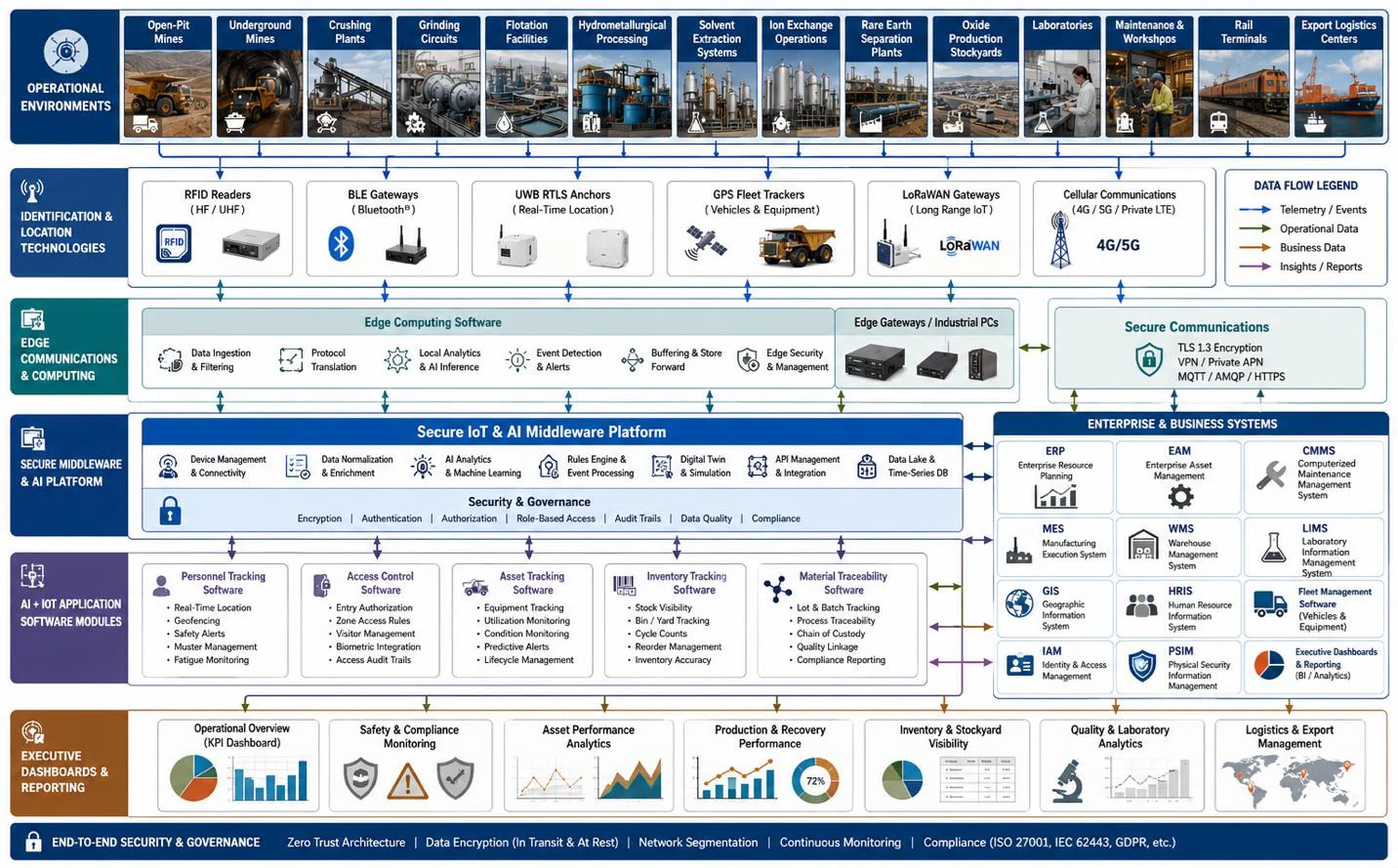
Enterprise AI + IoT Integration Architecture for Secure Rare Earth and Critical Mineral Operations
This enterprise integration block diagram illustrates the secure flow of identification and location data from mining operations through edge computing, AI middleware, operational software, and enterprise business systems. It demonstrates how RFID, BLE, UWB RTLS, GPS, LoRaWAN, and cellular technologies synchronize with tracking, inventory, maintenance, laboratory, and business platforms to provide real-time visibility, operational intelligence, regulatory compliance, and executive decision support across the rare earth and critical mineral production lifecycle.
Engineering Best Practices for AI and IoT Software Deployments
Successful implementation requires more than selecting identification technologies. Long-term operational success depends on aligning software configuration with mining workflows, production objectives, enterprise integration requirements, cybersecurity policies, and operational governance.
Recommended engineering practices include:
- Perform a comprehensive operational workflow assessment before deployment.
- Define standardized identification conventions for personnel, contractors, equipment, vehicles, warehouses, production areas, stockpiles, and processing batches.
- Select RFID, BLE, UWB RTLS, GPS, LoRaWAN, and cellular technologies according to operational range, positioning accuracy, environmental conditions, and infrastructure availability.
- Establish standardized digital identifiers for ore stockpiles, concentrate batches, mixed rare earth carbonate, rare earth oxides, warehouse inventory, and export consignments.
- Integrate operational software with ERP, EAM, CMMS, WMS, MES, LIMS, GIS, HRIS, and security systems wherever appropriate.
- Configure role-based access permissions according to operational responsibilities and regulatory requirements.
- Validate wireless coverage across mining areas, processing facilities, warehouses, maintenance workshops, laboratories, and logistics operations before production rollout.
- Conduct phased pilot deployments prior to enterprise-wide implementation.
- Define backup procedures, disaster recovery strategies, cybersecurity controls, and software lifecycle management policies.
- Monitor operational performance indicators and continuously refine workflows using historical operational data.
These engineering practices improve software reliability, data consistency, workforce accountability, equipment utilization, inventory accuracy, and enterprise-wide operational visibility.
Why Choose RareMetal AI
RareMetal AI combines practical industrial IoT deployment experience with deep technical expertise in enterprise identification and location solutions for the Mining & Resources Industry.
Developed within Aperture Venture Studio with support from GAO, RareMetal AI builds upon more than twenty years of industrial IoT experience gained through thousands of successful projects across mining, manufacturing, logistics, utilities, and other industrial sectors. Continuous investment in research and development, rigorous quality assurance processes, and engineering leadership from Ph.D. professionals help ensure software is designed for demanding industrial environments.
The engineering team has supported Fortune 500 companies, internationally recognized research organizations, prestigious universities, and government agencies throughout the United States and Canada. This practical experience enables RareMetal AI to deliver software that integrates with existing operational workflows, supports long-term maintainability, and provides reliable identification and location management across rare earth and critical mineral operations without disrupting established enterprise systems.
Contact RareMetal AI
Whether your organization operates an open-pit mine, underground mining operation, concentrator, hydrometallurgical processing plant, solvent extraction facility, ion exchange plant, rare earth separation facility, oxide production plant, refinery, maintenance workshop, warehouse, stockyard, or export logistics terminal, RareMetal AI can assist with planning and implementing enterprise AI and IoT identification and location solutions.
Contact Us