
AIoT Integration for Rare Earth & Critical Mineral Operations
AI of Things, commonly referred to as AIoT or AI and IoT, combines AI with connected industrial devices, identification technologies, industrial software, machine learning, Edge AI, computer vision where appropriate, and enterprise business systems. Within rare earth and critical mineral operations, AIoT integration primarily focuses on connecting identification and location technologies with enterprise software responsible for mining operations, mineral beneficiation, hydrometallurgical processing, solvent extraction, refining, warehousing, maintenance, logistics, and compliance.
Unlike traditional software deployments where operational applications frequently function independently, AIoT integration establishes secure information exchange between operational systems. Identification events generated throughout the mining lifecycle become immediately available to authorized enterprise applications, allowing every department to reference consistent operational information.
This approach is particularly valuable because rare earth production involves multiple transformation stages, including:
- Ore extraction from bastnäsite, monazite, xenotime, and ionic clay deposits.
- Crushing and grinding operations.
- Beneficiation and froth flotation.
- Concentrate transportation.
- Hydrometallurgical processing.
- Solvent extraction (SX).
- Ion exchange purification.
- Calcination.
- Rare earth oxide production.
- Packaging and warehousing.
- Domestic distribution and international export.
Each production stage generates operational events that must remain synchronized with enterprise software supporting maintenance, production planning, inventory reconciliation, financial reporting, logistics, and regulatory compliance.
AI and IoT integration allows organizations to associate personnel accountability records, equipment identification, material transfers, inventory transactions, maintenance activities, and chain-of-custody documentation with each operational phase. The resulting information continuity improves operational transparency while supporting responsible sourcing initiatives, conflict-free mineral verification, ESG reporting, and customer documentation requirements.
Organizations producing light rare earth elements (LREEs), heavy rare earth elements (HREEs), battery materials, and strategic minerals increasingly depend on integrated enterprise software because fragmented operational records reduce production visibility and increase administrative overhead.
Rather than replacing existing enterprise investments, AIoT integration extends the value of established mining applications by enabling secure interoperability between operational software, business systems, and executive reporting solutions.
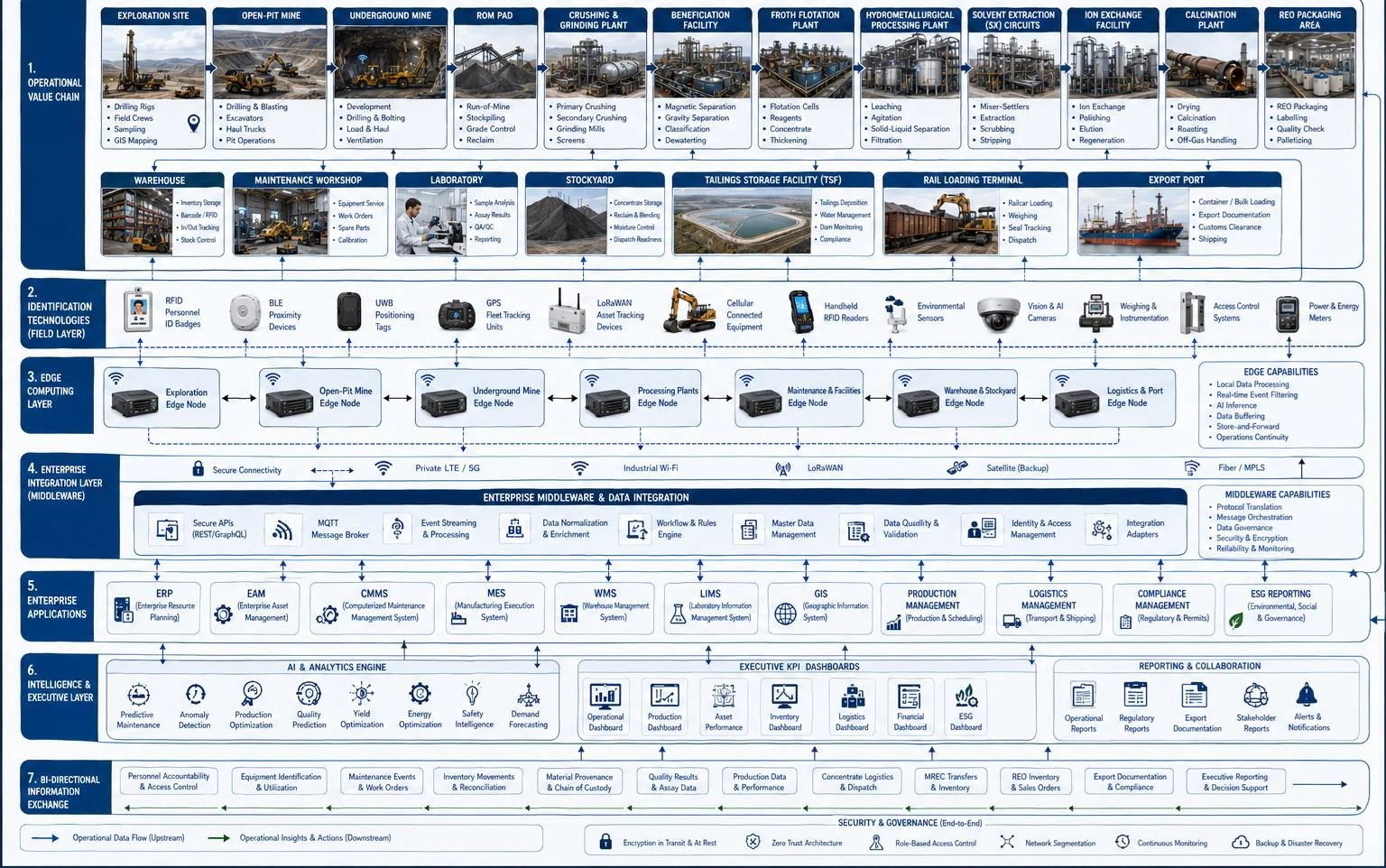
Enterprise AIoT Integration Architecture for Rare Earth and Critical Mineral Operations
This enterprise block diagram illustrates how AIoT technologies integrate operational data across the complete rare earth and critical mineral value chain, from exploration and mining through processing, warehousing, logistics, and export. It shows how identification technologies, edge computing, enterprise middleware, secure communications, and business applications exchange real-time information to support workforce accountability, equipment management, inventory reconciliation, production reporting, material provenance, and chain-of-custody documentation.
Middleware & Data Synchronization for Rare Earth & Critical Mineral Operations
Modern rare earth mining organizations often operate dozens of specialized software applications supporting geology, mine planning, production scheduling, maintenance management, warehouse operations, quality assurance, laboratory testing, logistics, environmental reporting, financial management, export documentation, and regulatory compliance.
Without enterprise integration, these applications frequently maintain separate operational records, creating inconsistencies that require extensive manual reconciliation. Equipment movements may appear in maintenance software before inventory applications are updated, warehouse transactions may not immediately synchronize with ERP systems, and production reporting may depend on delayed manual data transfers.
Enterprise middleware addresses these challenges by serving as the secure software layer responsible for coordinating operational information exchange across business systems while preserving transaction integrity, security, traceability, and auditability.
Rather than requiring manual synchronization, middleware automatically exchanges validated operational events using secure APIs, message queues, MQTT messaging where appropriate, RESTful web services, event-driven processing, and standardized enterprise integration methods.
For example, when authorized personnel enter a controlled solvent extraction facility, the access verification event can automatically update workforce accountability software, emergency response systems, security audit records, production scheduling applications, and regulatory compliance documentation. Similarly, relocating a mobile crusher, haul truck, drill rig, or separation module automatically updates maintenance scheduling, equipment utilization reports, inventory records, and financial asset management systems.
Modern AI-assisted middleware also improves operational quality by detecting duplicate transactions, identifying inconsistent workflows, validating timestamp sequences, and highlighting synchronization conflicts before inaccurate information propagates throughout enterprise systems.
Mining organizations operating remote sites often experience intermittent communications caused by geographical distance, network maintenance, or environmental conditions. Enterprise synchronization software therefore incorporates store-and-forward processing, transaction buffering, automated retry mechanisms, conflict resolution, comprehensive audit logging, and timestamp validation to ensure that operational records remain complete and trustworthy even during temporary communication outages.
RareMetal AI applies decades of industrial IoT deployment experience developed within Aperture Venture Studio and supported by GAO. This experience includes thousands of industrial IoT implementations across mining and other industrial sectors, supported by rigorous quality assurance, extensive research and development, and engineering teams with expertise in enterprise integration, industrial communications, AI-assisted software development, and operational technology. The result is dependable AIoT integration that enables mining organizations to maximize existing software investments while supporting future digital transformation initiatives.
Edge Processing Systems for Rare Earth & Critical Mineral Operations
Rare earth and critical mineral operations frequently span remote exploration areas, open-pit mines, underground workings, mineral processing plants, solvent extraction facilities, hydrometallurgical processing circuits, calcination plants, rare earth oxide (REO) packaging facilities, stockyards, and export terminals. Because many of these locations operate with variable network connectivity, AIoT integration relies on edge processing systems that continue processing operational events locally while maintaining synchronization with enterprise software whenever communications become available.
Edge processing places computing resources close to operational activities rather than depending exclusively on centralized data centers. This approach minimizes communication latency, improves operational resilience, and enables business-critical identification workflows to continue during temporary network interruptions.
Cloud Deployment for Rare Earth & Critical Mineral Operations
Cloud deployment enables geographically distributed mining organizations to consolidate operational information from exploration projects, mining operations, mineral processing plants, separation facilities, refineries, warehouses, maintenance centers, laboratories, and corporate offices into centrally managed enterprise software environments.
Organizations producing strategic minerals often operate numerous facilities across multiple regions. Cloud deployment provides standardized software management, centralized reporting, simplified version control, automated disaster recovery, and scalable computing resources while allowing each operational site to maintain independent workflows.
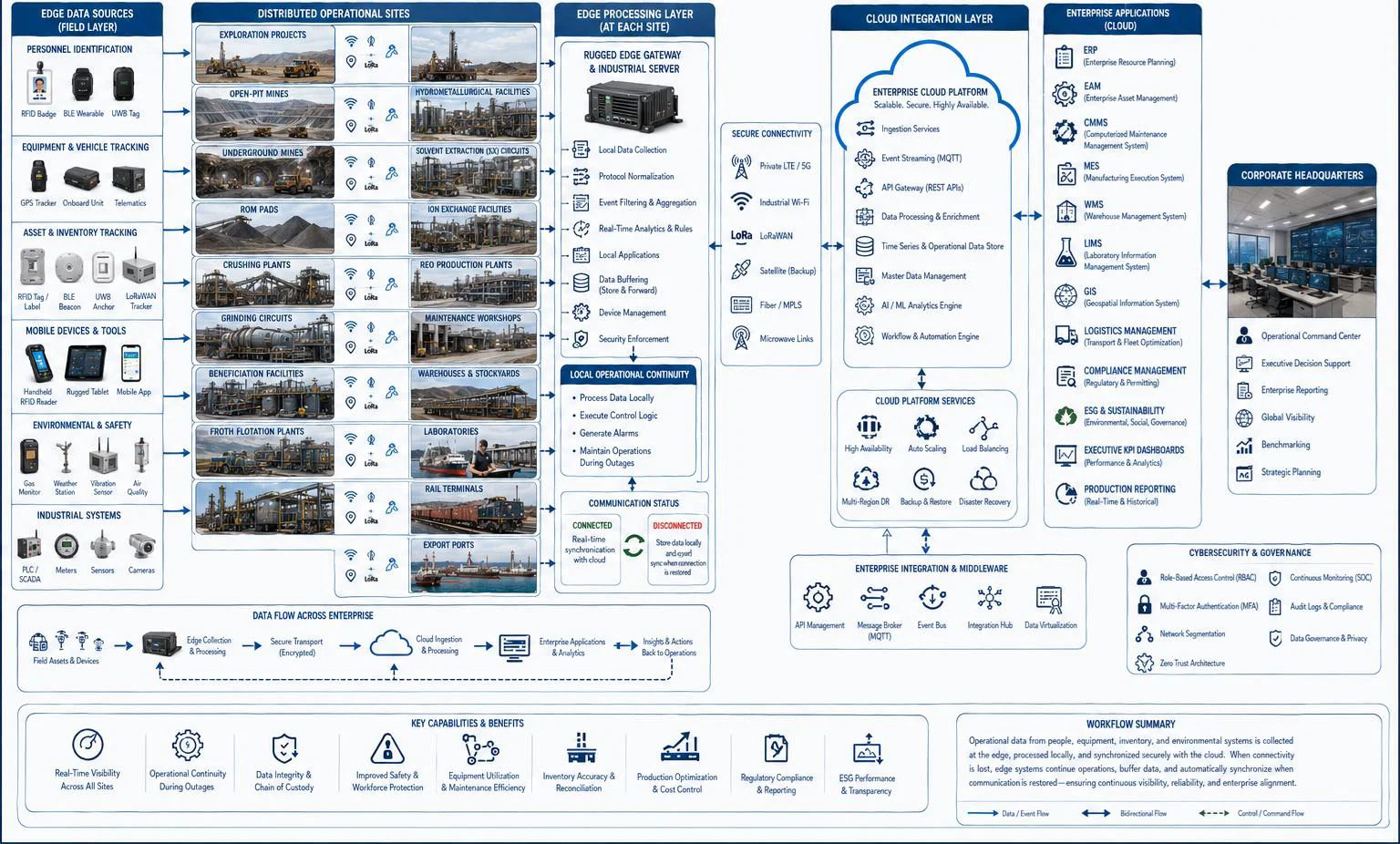
AI + IoT Edge Processing and Cloud Integration Workflow for Rare Earth and Critical Mineral Operations
This enterprise workflow diagram illustrates how AI and IoT edge computing systems collect, process, and securely synchronize operational data across geographically distributed rare earth and critical mineral operations. It demonstrates continuous data flows from personnel, equipment, processing facilities, warehouses, laboratories, and logistics assets through rugged edge gateways into centralized cloud platforms supporting ERP, EAM, CMMS, MES, WMS, LIMS, GIS, compliance, ESG reporting, and executive dashboards. The primary technical takeaway is that resilient edge processing with secure store-and-forward synchronization enables uninterrupted operations, enterprise-wide visibility, cybersecurity, and reliable decision-making even during intermittent network connectivity.
Server Deployment for Rare Earth & Critical Mineral Operations
Many rare earth and critical mineral producers continue to deploy enterprise software within privately managed data centers to satisfy cybersecurity requirements, operational resilience objectives, regulatory obligations, export control requirements, and protection of proprietary mineral processing knowledge. On-premises server deployments remain an important option for organizations operating strategic mineral assets, government-regulated facilities, defense-related supply chains, and advanced rare earth refining operations.
Server deployment allows AI and IoT integration software to operate entirely within the organization's secured network infrastructure while providing complete administrative control over computing resources, cybersecurity policies, software lifecycle management, backup procedures, disaster recovery strategies, and user access management.
Enterprise Connectivity Across Rare Earth & Critical Mineral Operations
Reliable enterprise connectivity enables AI and IoT software to exchange trusted operational information across every stage of the rare earth and critical mineral value chain. From exploration through mining, beneficiation, hydrometallurgical processing, separation, refining, warehousing, logistics, and export, integrated communications ensure that operational records remain synchronized across multiple facilities and business systems.
Rare earth organizations often operate geographically distributed sites that include open-pit mines, underground workings, concentrators, solvent extraction facilities, rare earth oxide production plants, laboratories, maintenance workshops, warehouses, rail terminals, and export ports. These facilities generate thousands of operational identification events every day that must be securely exchanged between enterprise applications.
Secure Data Exchange Across Mining and Mineral Processing Operations
Trusted enterprise data exchange forms the operational foundation of AI and IoT integration. Every personnel identification event, equipment movement, inventory transaction, warehouse transfer, maintenance activity, production record, and logistics operation contributes to a comprehensive digital operational record that supports production planning, regulatory compliance, responsible sourcing, ESG reporting, and executive decision-making.
Standardized information exchange eliminates many of the inconsistencies that arise when individual departments maintain independent operational records. Finance, operations, maintenance, logistics, warehousing, production, quality assurance, compliance, and executive leadership can all reference the same validated operational information.
Why Choose RareMetal AI
Rare earth and critical mineral operations require enterprise AI and IoT integration that reflects the operational realities of mining, mineral processing, and refining rather than generic industrial software implementations. Successful projects depend on reliable interoperability, secure information exchange, long-term maintainability, and deep knowledge of mining workflows.
RareMetal AI was created within Aperture Venture Studio with support from GAO and builds upon two decades of industrial IoT experience across thousands of successful deployments. Extensive investment in research and development, rigorous quality assurance processes, and continuous product improvement enables the company to deliver dependable AI and IoT integration solutions for complex industrial environments.
- Enterprise-grade AI and IoT integration expertise.
- Mining-focused software engineering.
- Reliable middleware development.
- Secure enterprise interoperability.
- Flexible cloud, server, edge, and hybrid deployment models.
- Standards-based integration methods.
- Comprehensive technical documentation.
- Long-term software lifecycle support.
- Remote and on-site engineering assistance.
- Rigorous software validation and quality assurance.
Our multidisciplinary engineering team includes Ph.D.-level professionals, enterprise software specialists, industrial communication experts, AI engineers, cybersecurity professionals, and experienced solution architects who understand the operational challenges associated with strategic mineral extraction, beneficiation, hydrometallurgy, solvent extraction, refining, warehousing, and logistics.
Contact RareMetal AI
Whether your organization operates a single rare earth processing facility or manages geographically distributed mining, beneficiation, refining, warehousing, and export operations, RareMetal AI can help develop an enterprise AI and IoT integration strategy aligned with your operational and business objectives.
Transform Enterprise Mining Operations with AIoT Integration
Reliable enterprise integration is the foundation of modern rare earth and critical mineral operations. As organizations expand production capacity, improve beneficiation efficiency, optimize solvent extraction, strengthen responsible sourcing, and increase rare earth oxide production, the need for accurate and synchronized operational information becomes increasingly important.
RareMetal AI delivers enterprise AI and IoT integration solutions that connect RFID, BLE, Ultra-Wideband (UWB), GPS, LoRaWAN, edge computing, enterprise middleware, ERP, EAM, CMMS, MES, WMS, LIMS, GIS, cloud environments, and private server infrastructure into a unified operational framework.
By establishing secure information exchange throughout mining, mineral processing, refining, warehousing, logistics, and export operations, organizations can improve operational transparency, reduce manual reconciliation, strengthen cybersecurity, simplify regulatory reporting, support chain-of-custody verification, enhance responsible sourcing initiatives, and maximize the long-term value of enterprise software investments.
Whether your objective is modernizing a single rare earth processing facility or integrating multiple strategic mineral operations across global production networks, RareMetal AI provides the technical expertise and enterprise AI and IoT solutions required to support secure, scalable, and reliable digital operations throughout the complete rare earth and critical mineral value chain.
Contact Us