
AI Software for Rare Earth Mining, Critical Mineral Processing & AIoT Operations | RareMetal AI

Enterprise AI and IoT software for rare earth mining and critical mineral operations. Improve personnel location analytics, access verification, mobile equipment utilization, stockpile inventory reconciliation, process stage visibility, and mineral chain of custody using RFID, BLE, UWB, GPS, LoRaWAN, private LTE, and private 5G technologies.

Site Access Verification

Rare earth and critical mineral operations contain numerous operational areas where access must be tightly controlled to protect personnel, strategic mineral inventories, proprietary refining processes, hazardous reagents, high-value equipment, and critical production infrastructure. Unlike conventional industrial facilities, these operations frequently include solvent extraction circuits, ion exchange processing areas, hydrometallurgical plants, rare earth oxide production facilities, assay laboratories, explosives magazines, reagent storage buildings, electrical substations, maintenance workshops, export staging areas, and secure warehouses containing high-value concentrates and refined products.

Traditional electronic access control systems typically verify credentials only at entry points. While effective for opening doors or gates, they often provide limited operational insight into workforce movement after entry has been granted. AI and IoT software extends access verification by continuously evaluating identification events against approved work assignments, contractor schedules, shift rosters, maintenance activities, work permits, historical movement patterns, and operational policies.

Rather than simply confirming whether an individual entered a restricted area, AI software evaluates the operational context surrounding that movement. This provides supervisors with a more complete understanding of workforce activity while reducing unnecessary investigations caused by isolated credential events.

RFID employee credentials, BLE identification badges, UWB location tags, GPS devices for surface operations, and private LTE or private 5G communications collectively provide continuous identification and location visibility throughout mining complexes. AI software organizes this information into meaningful operational recommendations that strengthen workforce accountability while improving compliance with environmental, health, safety, and security requirements.

Benefits include:

  • Improved operational security
  • Better workforce accountability
  • Reduced unauthorized access risks
  • Faster incident investigations
  • Enhanced contractor management
  • Improved audit readiness
  • More accurate regulatory documentation
  • Simplified compliance reporting
  • Reduced manual administrative effort
  • Greater operational transparency

For organizations producing strategic minerals used in defense systems, electric vehicles, renewable energy technologies, and semiconductor manufacturing, maintaining comprehensive access documentation has become increasingly important for both operational governance and customer confidence.

Rare Earth Radiological Zone Access Verification

Many rare earth deposits naturally contain thorium, uranium, or other radioactive elements that require specialized handling throughout mining and mineral processing operations. Personnel entering designated radiological work areas must often possess current training certifications, approved work authorizations, radiation safety qualifications, and appropriate operational assignments.

AI software evaluates identification events together with workforce qualifications, approved work permits, scheduled maintenance activities, contractor authorizations, and supervisor approvals before confirming operational access.

Historical movement records provide environmental health and safety teams with complete documentation supporting:

  • Radiation protection programs
  • Personnel exposure management
  • Regulatory inspections
  • Internal compliance reviews
  • Operational safety investigations
  • Workforce certification verification

Because access history is continuously maintained, organizations reduce the effort required to reconstruct personnel activities during audits or incident reviews.

Rare Earth Hazardous Area Entry Authorization

Hydrometallurgical processing plants frequently utilize sulfuric acid, hydrochloric acid, nitric acid, sodium hydroxide, ammonium compounds, oxalic acid, extraction solvents, precipitation reagents, and other chemicals requiring controlled personnel access.

Production areas containing pressure vessels, high-temperature calcination furnaces, filtration systems, reagent preparation facilities, chemical storage buildings, and oxide processing lines also require carefully managed workforce authorization.

AI software evaluates worker eligibility before permitting operational access based upon:

  • Required certifications
  • Active work permits
  • Shift assignments
  • Supervisor approvals
  • Maintenance schedules
  • Contractor authorization
  • Operational work orders
  • Temporary access approvals

Historical authorization records help organizations review recurring operational issues, improve workforce planning, and strengthen compliance with internal operating procedures while reducing administrative documentation.

Critical Mineral Contractor Credential Verification

Rare earth production facilities routinely engage specialized contractors for drilling, blasting, electrical maintenance, mechanical repairs, refractory replacement, conveyor servicing, laboratory support, instrumentation calibration, process optimization, civil construction, equipment commissioning, and shutdown maintenance.

Managing contractor access across multiple operating areas becomes increasingly challenging when several organizations perform work simultaneously throughout large mining properties.

AI software compares contractor credentials with:

  • Approved work permits
  • Scheduled maintenance activities
  • Assigned work locations
  • Authorized supervisors
  • Project duration
  • Shift schedules
  • Equipment assignments
  • Access authorization periods

When identification activity differs from planned operational activities, supervisors receive prioritized notifications for evaluation.

Operational improvements include:

  • Faster contractor onboarding
  • Reduced manual credential verification
  • Improved project accountability
  • Better workforce coordination
  • More accurate contractor documentation
  • Simplified compliance reporting
  • Stronger operational governance

Historical verification records also simplify project closeout documentation and contractor performance evaluations.

Strategic Resource Access Anomaly Detection

Rare earth separation facilities and critical mineral refineries frequently process materials supporting aerospace manufacturing, advanced defense systems, electric motors, permanent magnets, battery technologies, optical systems, and semiconductor fabrication. These facilities require continuous operational oversight beyond conventional badge access systems.

AI software evaluates identification history to recognize operational behaviors that differ from established workforce patterns.

Examples include:

  • Unexpected after-hours access
  • Repeated entry attempts into unrelated production areas
  • Unusual movement between solvent extraction and refining buildings
  • Credential activity inconsistent with assigned responsibilities
  • Extended occupancy inside controlled processing areas
  • Simultaneous identification events that require investigation
  • Repeated access attempts following expired work authorization

Instead of overwhelming supervisors with large volumes of notifications, AI prioritizes operationally significant events according to organizational policies and historical workforce behavior.

This approach improves operational oversight while reducing alert fatigue across large industrial mining facilities.

Asset Location Analytics

Rare earth and critical mineral production depends upon continuous availability of highly specialized mobile equipment, production assets, maintenance resources, laboratory equipment, transport vehicles, processing containers, lifting equipment, and warehouse handling systems. Delays in locating these assets can interrupt ore movement, slow maintenance activities, delay laboratory analysis, reduce processing throughput, and increase operating costs.

Asset Location Analytics applies AI to identification and location information collected through RFID, BLE, UWB, GPS, LoRaWAN, private LTE, and cellular communication technologies. Instead of simply displaying equipment locations on a map, AI software continuously analyzes movement history, equipment utilization, dispatch activity, idle time, operational availability, travel frequency, maintenance coordination, and deployment efficiency.

Mining organizations gain operational visibility across assets including:

  • Electric rope shovels
  • Hydraulic excavators
  • Blast hole drill rigs
  • Underground load-haul-dump (LHD) machines
  • Underground haul trucks
  • Surface haul trucks
  • Wheel loaders
  • Dozers
  • Motor graders
  • Water trucks
  • Fuel service vehicles
  • Mobile maintenance trucks
  • Mobile cranes
  • Forklifts
  • Ore containers
  • Rare earth concentrate containers
  • Laboratory sample carts
  • Portable lifting equipment
  • Mobile generators
  • Critical spare equipment
  • Warehouse material handling equipment

Continuous identification records help operations managers improve production coordination while reducing unnecessary equipment movement across geographically distributed mining operations.

RareMetal AI combines decades of industrial IoT experience with practical mining deployment expertise to deliver AI and IoT software capable of supporting complex strategic mineral production environments. Backed by significant investments in research and development, comprehensive quality assurance processes, and engineering leadership from Ph.D. professionals, the software has been developed using practical experience gained from thousands of industrial IoT implementations.

Rare Earth Mobile Equipment Location Analytics

Mining fleets continuously relocate according to ore extraction priorities, grade control programs, stripping activities, waste movement, haul road conditions, production campaigns, and maintenance requirements.

AI software evaluates equipment movement together with dispatch history, operator assignments, production schedules, maintenance planning, and historical utilization to provide actionable operational recommendations.

These analytics support:

  • Fleet utilization optimization
  • Equipment balancing across mining zones
  • Reduced idle equipment time
  • Improved dispatch efficiency
  • Shorter equipment search times
  • Better shift planning
  • Improved maintenance scheduling
  • More efficient production coordination

Historical utilization trends also assist long-term capital planning by identifying opportunities to maximize existing equipment before additional fleet investments are required.

Critical Mineral Processing Equipment Utilization Analytics

Beneficiation plants, flotation circuits, magnetic separation facilities, hydrometallurgical processing units, solvent extraction operations, ion exchange systems, calcination equipment, packaging stations, and warehouse operations depend upon coordinated movement of production support assets.

AI software analyzes identification histories associated with mobile maintenance equipment, specialized processing assets, warehouse handling equipment, laboratory resources, and logistics vehicles to improve operational workflow visibility.

Managers gain insights into:

  • Equipment availability
  • Maintenance coordination
  • Asset utilization trends
  • Resource allocation efficiency
  • Shift-by-shift utilization
  • Workflow bottlenecks
  • Equipment movement frequency
  • Operational support efficiency

These analytics enable production planners to allocate resources more effectively while minimizing disruptions throughout mineral processing operations.

Strategic Mining Machinery Movement Prediction

Historical equipment movement provides valuable information for forecasting future operational demand across mining and processing activities.

AI software analyzes production campaigns, haulage patterns, maintenance schedules, dispatch history, seasonal operating conditions, and historical relocation activities to estimate future machinery requirements.

Forecasting assists organizations with:

  • Preventive maintenance planning
  • Equipment staging
  • Workforce scheduling
  • Spare equipment allocation
  • Fuel logistics planning
  • Production campaign preparation
  • Long-term operational planning

Predictive movement recommendations help reduce unnecessary equipment relocation while supporting more efficient utilization of existing mining assets.

Rare Earth Separation Plant Asset Tracking

Rare earth separation facilities contain numerous specialized mobile assets supporting laboratory operations, maintenance teams, warehouse personnel, quality assurance, packaging activities, and production support.

AI software continuously maintains identification histories as tagged assets move between laboratories, maintenance workshops, processing buildings, warehouse storage areas, packaging facilities, inspection stations, and shipping operations.

Operational benefits include:

  • Faster asset retrieval
  • Improved maintenance coordination
  • Reduced equipment search time
  • Better laboratory equipment availability
  • Stronger capital asset accountability
  • Improved warehouse efficiency
  • Enhanced production continuity
  • Comprehensive equipment movement history

These continuously updated identification records also support capital asset audits, insurance documentation, maintenance history verification, lifecycle management, and long-term operational planning across complex rare earth and critical mineral production facilities.

Stockpile Inventory Analytics

Rare earth and critical mineral inventory management is considerably more complex than conventional bulk commodity inventory control because materials are continuously transformed throughout multiple processing stages while simultaneously varying by mineralogy, grade, recovery rate, chemical composition, moisture content, particle size, and commercial value. A single operation may simultaneously manage run-of-mine (ROM) ore, crushed ore, blended feedstock, flotation concentrate, magnetic concentrate, mixed rare earth carbonate (MREC), partially refined intermediate products, separated rare earth compounds, high-purity rare earth oxides, recycled process materials, laboratory retention samples, packaging materials, and export-ready shipments.

Maintaining accurate inventory accountability throughout these production stages is essential for production planning, process scheduling, financial reporting, customer fulfillment, and regulatory compliance. Manual inventory reconciliation often becomes labor-intensive because materials move continuously between stockpiles, surge bins, warehouses, concentrators, hydrometallurgical processing facilities, solvent extraction circuits, calcination plants, packaging lines, and export logistics terminals.

AI and IoT software improves inventory management by combining identification and location information with operational workflows. RFID, BLE, GPS, LoRaWAN, UWB, and cellular identification technologies enable tagged containers, pallets, storage locations, transport vehicles, and warehouse handling equipment to be automatically identified as materials move throughout production. AI software analyzes these identification records to identify inventory trends, reconcile material transfers, improve storage utilization, and support production planning.

Rather than replacing warehouse management or ERP software, AI functions provide operational context that improves inventory accuracy and minimizes manual reconciliation activities.

Operational benefits include:

  • Improved stockpile visibility
  • Faster inventory reconciliation
  • Reduced manual inventory counting
  • Better warehouse organization
  • Improved ore blending coordination
  • More accurate production scheduling
  • Reduced material search time
  • Better inventory turnover analysis
  • Improved working capital utilization
  • Enhanced export logistics preparation
  • Stronger inventory accountability
  • Better executive reporting across multiple mining operations

Historical inventory movement also supports production forecasting, strategic reserve planning, commercial reporting, and long-term operational optimization.

Rare Earth Ore Inventory Analytics

Ore inventories directly influence concentrator utilization, downstream processing capacity, ore blending strategies, recovery efficiency, and production continuity. Maintaining accurate identification histories throughout mining, hauling, stockpiling, reclaiming, and processing enables planners to optimize material allocation while reducing unnecessary ore movement.

AI software analyzes identified ore transfers between:

  • Mining faces
  • Haul trucks
  • Primary crushers
  • Secondary crushing facilities
  • ROM stockpiles
  • Blending stockpiles
  • Reclaim systems
  • Grinding circuits
  • Beneficiation plants

Historical movement analysis allows production planners to evaluate stockpile utilization, inventory aging, reclaim priorities, and operational efficiency.

Organizations benefit from:

  • Better ore availability forecasting
  • Improved blending consistency
  • Reduced unnecessary material handling
  • Improved crusher utilization
  • Better production coordination
  • Enhanced inventory reporting

These insights contribute to more stable processing operations while supporting consistent plant feed quality.

Strategic Mineral Oxide Inventory Optimization

Rare earth oxides such as neodymium oxide, praseodymium oxide, dysprosium oxide, terbium oxide, cerium oxide, lanthanum oxide, and yttrium oxide typically represent the highest-value finished products within rare earth processing operations.

Maintaining precise accountability throughout packaging, warehouse storage, quality inspection, customer allocation, and export preparation is essential.

AI software evaluates identification histories associated with finished oxide inventory as materials progress through:

  • Packaging stations
  • Inspection areas
  • Warehouse storage
  • Export staging
  • Shipping preparation
  • Distribution logistics

Operational improvements include:

  • Improved finished goods accountability
  • Reduced inventory discrepancies
  • Better warehouse organization
  • Faster shipment preparation
  • Improved customer order fulfillment
  • Better inventory allocation
  • Simplified commercial reporting

Historical inventory analysis also assists sales planning and production scheduling by providing greater confidence in available finished inventory.

Critical Mineral Concentrate Stockpile Volume Forecasting

Concentrate production frequently varies according to mining rates, beneficiation efficiency, maintenance shutdowns, customer demand, transportation availability, export schedules, and refining capacity.

AI software evaluates historical identification records associated with concentrate containers, storage areas, warehouse transfers, and outbound logistics to forecast future inventory requirements.

Forecasting supports:

  • Warehouse capacity planning
  • Export preparation
  • Shipping coordination
  • Material handling optimization
  • Inventory allocation
  • Production balancing
  • Customer delivery scheduling
  • Storage utilization planning

Predictive inventory recommendations allow organizations to proactively manage warehouse capacity before operational bottlenecks develop.

Rare Earth Inventory Reconciliation Analytics

Inventory reconciliation frequently requires personnel to compare physical inventory with ERP records, warehouse transactions, production documentation, shipping records, and manual inventory counts.

AI software continuously compares identification histories against enterprise inventory records to identify exceptions requiring investigation.

Examples include:

  • Unverified inventory transfers
  • Missing identification events
  • Duplicate inventory transactions
  • Unexpected warehouse movements
  • Incorrect storage assignments
  • Delayed inventory updates
  • Shipment reconciliation discrepancies
  • Material location inconsistencies

Rather than requiring manual review of every inventory transaction, AI prioritizes exceptions according to operational significance, allowing inventory specialists to focus their attention where corrective action is most valuable.

Process Stage Analytics

Rare earth production involves one of the most sophisticated mineral processing workflows within the mining industry. Material progresses through multiple extraction, beneficiation, separation, purification, refining, packaging, and logistics stages before becoming commercially available rare earth products.

Typical workflows include drilling, blasting, hauling, crushing, grinding, classification, flotation, magnetic separation, thickening, filtration, hydrometallurgical leaching, impurity removal, solvent extraction, ion exchange, precipitation, calcination, oxide production, packaging, warehousing, and shipment.

Each processing stage depends upon accurate identification of production batches, containers, transfer vessels, transport equipment, warehouse assets, and intermediate products.

AI and IoT software analyzes identification and location events throughout these workflows to improve production visibility without introducing additional manual reporting requirements.

Instead of monitoring process instrumentation, the software emphasizes identification and location continuity, enabling organizations to understand where production batches are located, how they move throughout operations, and how production progresses over time.

Operational advantages include:

  • Better production coordination
  • Improved workflow visibility
  • Enhanced batch accountability
  • Reduced manual production tracking
  • Faster operational reporting
  • Better production scheduling
  • Improved warehouse coordination
  • Stronger documentation supporting quality assurance
  • Better communication between mining, processing, maintenance, and logistics teams

Historical workflow analysis also assists continuous improvement initiatives by identifying recurring operational bottlenecks and workflow inefficiencies.

AI-Powered Rare Earth Inventory and Material Flow Workflow from Mine to Export

This workflow diagram illustrates how AI continuously monitors and reconciles rare earth inventory as materials move from run-of-mine stockpiles through processing, warehousing, packaging, and export operations. It highlights the integration of RFID, BLE, GPS, UWB, LoRaWAN, private LTE, AI analytics, and enterprise software to improve inventory visibility, stockpile forecasting, material traceability, operational reporting, and export readiness.
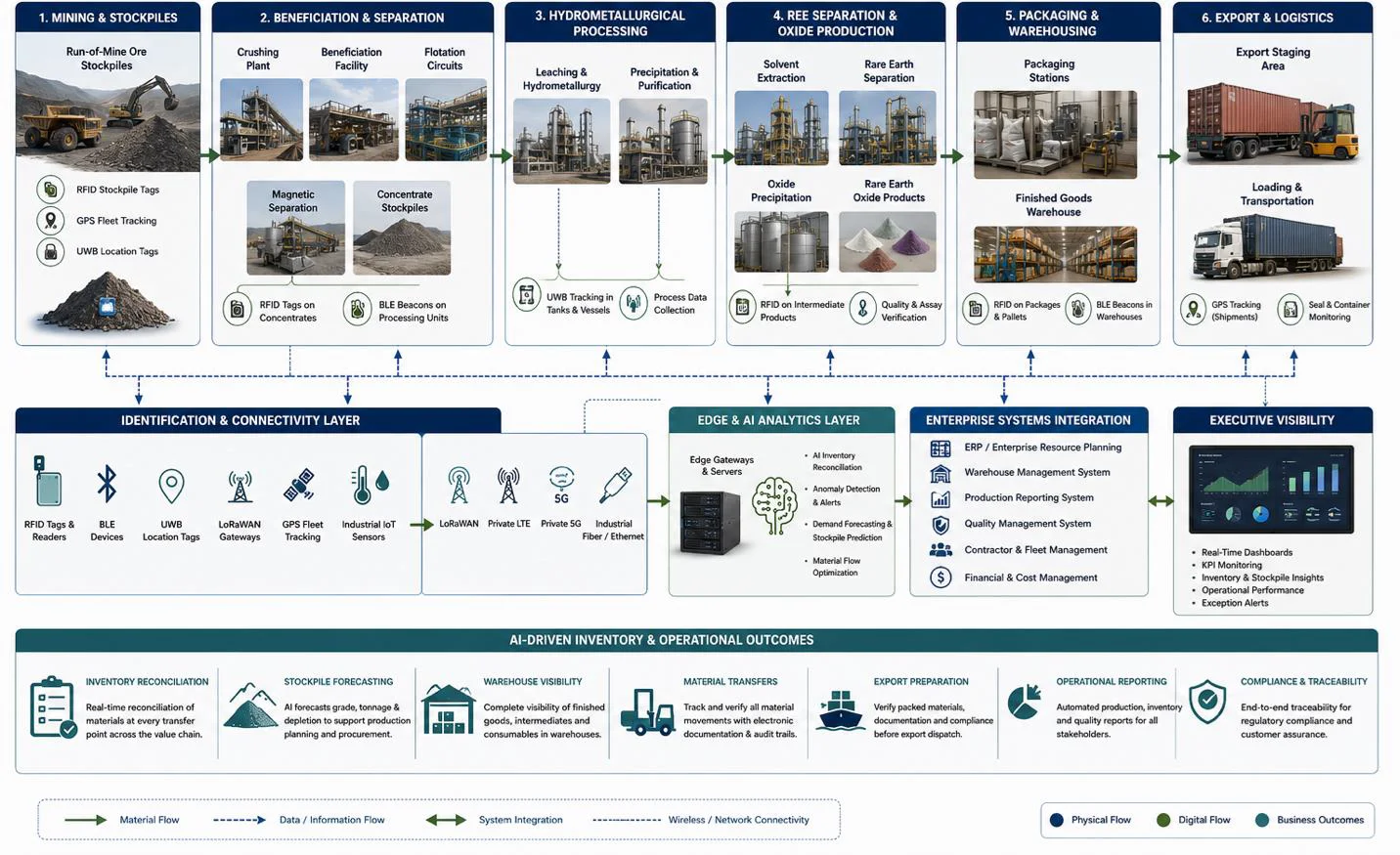
AI workflow tracking rare earth inventory from mining to export using RFID, BLE, GPS, UWB, and ERP integration.

Rare Earth Separation Process Stage Analytics

Rare earth separation plants frequently contain hundreds of sequential extraction stages where intermediate materials continuously move between extraction mixers, settlers, purification processes, precipitation systems, filtration equipment, drying operations, calcination facilities, and packaging stations.

AI software maintains identification histories associated with production containers and processing batches as materials progress throughout these operational workflows.

Production supervisors gain improved visibility into:

  • Current production stage
  • Material progression
  • Batch movement history
  • Production workflow continuity
  • Operational sequencing
  • Transfer verification
  • Production scheduling

Historical movement records also support continuous process improvement and operational documentation.

Rare Earth Solvent Extraction Stage Analytics

Solvent extraction remains one of the defining production stages within rare earth refining because multiple extraction and stripping cycles are required to separate chemically similar rare earth elements into individual products.

AI software analyzes identification histories associated with production batches as they move through extraction, purification, washing, concentration, precipitation, and intermediate storage operations.

Operational recommendations support:

  • Improved batch tracking
  • Better production coordination
  • Reduced documentation effort
  • Improved workflow visibility
  • Better scheduling between processing stages
  • Stronger production accountability

Historical production movement analysis also assists engineering teams when reviewing workflow consistency across multiple production campaigns.

Critical Mineral Leaching Circuit Progress Tracking

Hydrometallurgical processing commonly includes multiple leaching stages followed by purification, filtration, clarification, precipitation, and recovery operations.

AI software maintains complete identification histories for production batches as they move between designated processing areas.

Operational benefits include:

  • Improved batch accountability
  • Better production scheduling
  • Improved shift coordination
  • Reduced manual reporting
  • Better production documentation
  • Enhanced operational transparency

Managers obtain clearer production status information while reducing dependence on manually updated progress reports.

Strategic Mineral Refining Batch Progress Prediction

Accurately forecasting production completion enables warehouse operations, packaging teams, logistics coordinators, and commercial departments to prepare downstream activities more effectively.

AI software evaluates historical batch progression together with production workflows and identification histories to estimate expected completion timing.

Forecasting assists with:

  • Packaging preparation
  • Warehouse scheduling
  • Export logistics
  • Production planning
  • Customer delivery coordination
  • Resource allocation
  • Commercial scheduling

Improved production forecasting contributes to smoother coordination between processing, warehousing, transportation, and customer fulfillment while increasing operational predictability across rare earth and critical mineral production facilities.

Material Traceability Analytics

Rare earth elements and critical minerals are integral to electric vehicle traction motors, permanent magnet manufacturing, semiconductor fabrication, aerospace systems, advanced defense technologies, renewable energy infrastructure, medical devices, robotics, telecommunications, and numerous other strategic industries. Consequently, mining organizations are increasingly expected to demonstrate complete material provenance, responsible sourcing, regulatory compliance, and documented chain of custody from ore extraction through final shipment.

Unlike conventional commodity mining, rare earth operations frequently manage multiple intermediate products, including run-of-mine ore, blended feedstock, flotation concentrate, magnetic concentrate, mixed rare earth carbonate (MREC), solvent extraction feed, separated rare earth compounds, refined oxides, packaged products, and export consignments. Every transfer between these stages must be accurately documented to support quality assurance, customer requirements, export controls, environmental reporting, and internal governance.

AI and IoT software strengthens traceability by continuously organizing identification and location records generated through RFID, BLE, barcode, QR code, GPS, UWB, LoRaWAN, and cellular identification technologies. Rather than relying exclusively on manually maintained documentation, AI software automatically correlates material identification events with operational workflows, warehouse transfers, production batches, and shipping activities.

The resulting digital chain of custody supports:

  • Complete material provenance documentation
  • Responsible sourcing initiatives
  • Export control compliance
  • Internal quality assurance
  • Customer audit support
  • Inventory accountability
  • Regulatory reporting
  • Operational investigations
  • Commercial documentation
  • Executive reporting

Historical identification records also simplify retrospective investigations by allowing organizations to reconstruct material movement throughout the complete production lifecycle.

Rare Earth Ore Origin Chain Verification

Rare earth ore frequently originates from multiple mining zones, benches, ore bodies, or satellite deposits, each with different geological characteristics, mineralogy, grade distributions, and processing requirements.

AI software associates identified ore movements with extraction locations, haulage routes, stockpile assignments, blending operations, beneficiation circuits, and downstream processing stages.

Organizations gain the ability to verify:

  • Original extraction location
  • Material movement chronology
  • Stockpile allocation history
  • Production batch association
  • Processing pathway
  • Final product linkage

These capabilities improve production planning while strengthening documentation required for customer reporting and internal governance.

Critical Mineral Provenance Analytics

Manufacturers increasingly require detailed documentation demonstrating where critical minerals originated and how they progressed through extraction, concentration, refining, warehousing, and export.

AI software continuously organizes identification histories into structured provenance records covering:

  • Mining operations
  • Beneficiation facilities
  • Concentrate handling
  • Refining operations
  • Warehouse storage
  • Packaging activities
  • Export preparation
  • Distribution logistics

Well-documented provenance reduces manual record preparation while improving customer confidence and supporting international supply chain transparency initiatives.

Strategic Mineral Conflict-Free Sourcing Verification

Responsible sourcing has become a strategic objective for organizations supplying minerals to aerospace, defense, semiconductor, renewable energy, and electric vehicle manufacturers.

Although responsible sourcing programs often involve multiple business processes, AI-assisted identification records provide an additional layer of operational documentation by verifying material movement throughout controlled production environments.

Historical identification records support:

  • Internal compliance programs
  • Supplier qualification
  • Customer reporting
  • Environmental, social, and governance (ESG) initiatives
  • Operational governance
  • Documentation supporting responsible mineral sourcing

The result is improved operational transparency without increasing administrative workload.

Rare Earth Chain of Custody Audit Analytics

Comprehensive chain of custody documentation requires accurate identification records covering every operational transfer from extraction through shipment.

AI software continuously maintains chronological identification histories for:

  • Ore containers
  • Processing batches
  • Concentrate storage
  • Intermediate products
  • Warehouse inventory
  • Packaging operations
  • Shipping containers
  • Export staging facilities

Audit teams can rapidly retrieve historical movement records supporting:

  • Regulatory inspections
  • Customer qualification audits
  • Internal quality reviews
  • Export documentation
  • Production investigations
  • Inventory validation
  • Commercial reporting

Maintaining continuously updated identification histories significantly reduces the effort required to reconstruct historical material movement while improving confidence in operational documentation.

Why Choose RareMetal AI

Successful AI and IoT implementation within rare earth and critical mineral operations requires considerably more than software deployment. Effective solutions must align with complex mining workflows, mineral processing operations, warehouse logistics, workforce management, maintenance planning, and enterprise business systems while maintaining operational continuity.

RareMetal AI develops enterprise AI and IoT software specifically for identification and location applications across strategic mineral production. Rather than providing generic industrial software, the company focuses on operational visibility throughout mining, beneficiation, rare earth separation, refining, warehouse management, inventory reconciliation, and material traceability.

Key capabilities include:

  • Personnel location analytics for surface and underground operations
  • Workforce access verification for controlled operational areas
  • Mobile equipment identification and utilization analytics
  • Fleet location visibility across mining properties
  • Inventory reconciliation for ore, concentrates, intermediate products, and finished oxides
  • Production workflow visibility throughout mineral processing
  • Material provenance and chain of custody documentation
  • Enterprise integration with ERP, CMMS, MES, WMS, LIMS, dispatch, and access control software
  • Support for RFID, BLE, UWB, GPS, LoRaWAN, private LTE, private 5G, and cellular identification technologies
  • Cloud-hosted and customer-managed server deployments

RareMetal AI was created within Aperture Venture Studio with support from GAO. The software reflects more than two decades of industrial IoT experience acquired through thousands of successful customer projects across numerous industrial sectors. Extensive investments in research and development, rigorous quality assurance procedures, and expert engineering support enable organizations to deploy reliable AI and IoT solutions with confidence. The company is led by Ph.D. professionals and has supported Fortune 500 corporations, leading research institutions, prestigious universities, and government agencies throughout the United States and Canada.

Contact RareMetal AI

Whether your organization is modernizing an existing rare earth operation or planning a new AI and IoT deployment for a critical mineral project, RareMetal AI can help develop an identification and location solution tailored to your operational requirements.

Our engineering specialists work closely with mining companies, mineral processors, EPC firms, system integrators, and industrial technology teams to evaluate workflows, identify integration opportunities, and recommend deployment strategies that align with operational goals and existing enterprise systems.

Contact Us
Scroll to Top