
Enhancing Operational Visibility in Rare Earth and Critical Mineral Operations Using AI and IoT
Rare earth and critical mineral operations require significantly higher levels of operational visibility than conventional mining because these strategic resources support electric vehicles, permanent magnets, wind turbines, aerospace systems, semiconductor manufacturing, defense technologies, advanced electronics, battery production, and national critical infrastructure. Valuable materials such as bastnäsite, monazite, xenotime, scandium, neodymium, praseodymium, dysprosium, terbium, yttrium, and other rare earth elements move through multiple extraction, beneficiation, hydrometallurgical, separation, refining, storage, and logistics stages before reaching downstream manufacturers.
AI and IoT identification and location technologies enable mining organizations to automatically identify personnel, contractors, vehicles, mobile mining equipment, concentrate containers, rare earth oxides, warehouse inventory, maintenance assets, and production materials without relying on manual recordkeeping. Combining industrial identification hardware with enterprise AI software provides trusted operational data that supports workforce management, secure access verification, equipment utilization, inventory reconciliation, logistics coordination, and chain of custody documentation.
Understanding AI and IoT Identification and Location Technologies for Rare Earth & Critical Mineral Operations
Rare earth mining presents operational challenges that differ considerably from those encountered in coal, iron ore, or aggregate mining. Ore bodies often require complex beneficiation processes followed by hydrometallurgical extraction, solvent extraction, ion exchange, precipitation, calcination, oxide production, and advanced refining before marketable products are produced. Throughout these processes, personnel, mobile assets, processing equipment, intermediate products, and finished materials must be accurately identified and their locations reliably documented.
AI and IoT, commonly referred to as AIoT, combines AI with connected industrial identification devices, wireless communication technologies, edge computing, enterprise software, and machine learning to transform identification events into actionable operational information. Rather than simply recording where an asset was identified, AI software analyzes historical movement records, workforce deployment, equipment utilization, inventory history, authorized access events, logistics activities, and operational workflows to support more informed decision-making.
Identification technologies are deployed across virtually every operational area, including:
- Open-pit rare earth mines
- Underground critical mineral mines
- Ore crushing facilities
- Grinding and milling circuits
- Beneficiation plants
- Froth flotation facilities
- Hydrometallurgical leaching plants
- Solvent extraction (SX) circuits
- Ion exchange facilities
- Rare earth separation plants
- Oxide production facilities
- Refining plants
- Assay laboratories
- Warehouse operations
- Spare parts storage
- Maintenance workshops
- Fleet maintenance facilities
- Concentrate stockyards
- Finished oxide storage
- Rail loading terminals
- Export logistics centers
Each operational area has different requirements for identification accuracy, communication range, positioning precision, infrastructure availability, battery life, ruggedness, and cybersecurity. Consequently, enterprise mining organizations typically deploy multiple complementary wireless technologies rather than relying on a single identification method.
RareMetal AI applies practical engineering experience gained through decades of industrial IoT deployments supported by GAO. Developed within Aperture Venture Studio, our solutions are informed by thousands of successful industrial implementations, extensive research and development, rigorous quality assurance processes, and support delivered by experienced engineering professionals both remotely and onsite. This experience includes assisting Fortune 500 companies, leading research institutions, prestigious universities, and government agencies in deploying industrial identification solutions across complex operational environments.
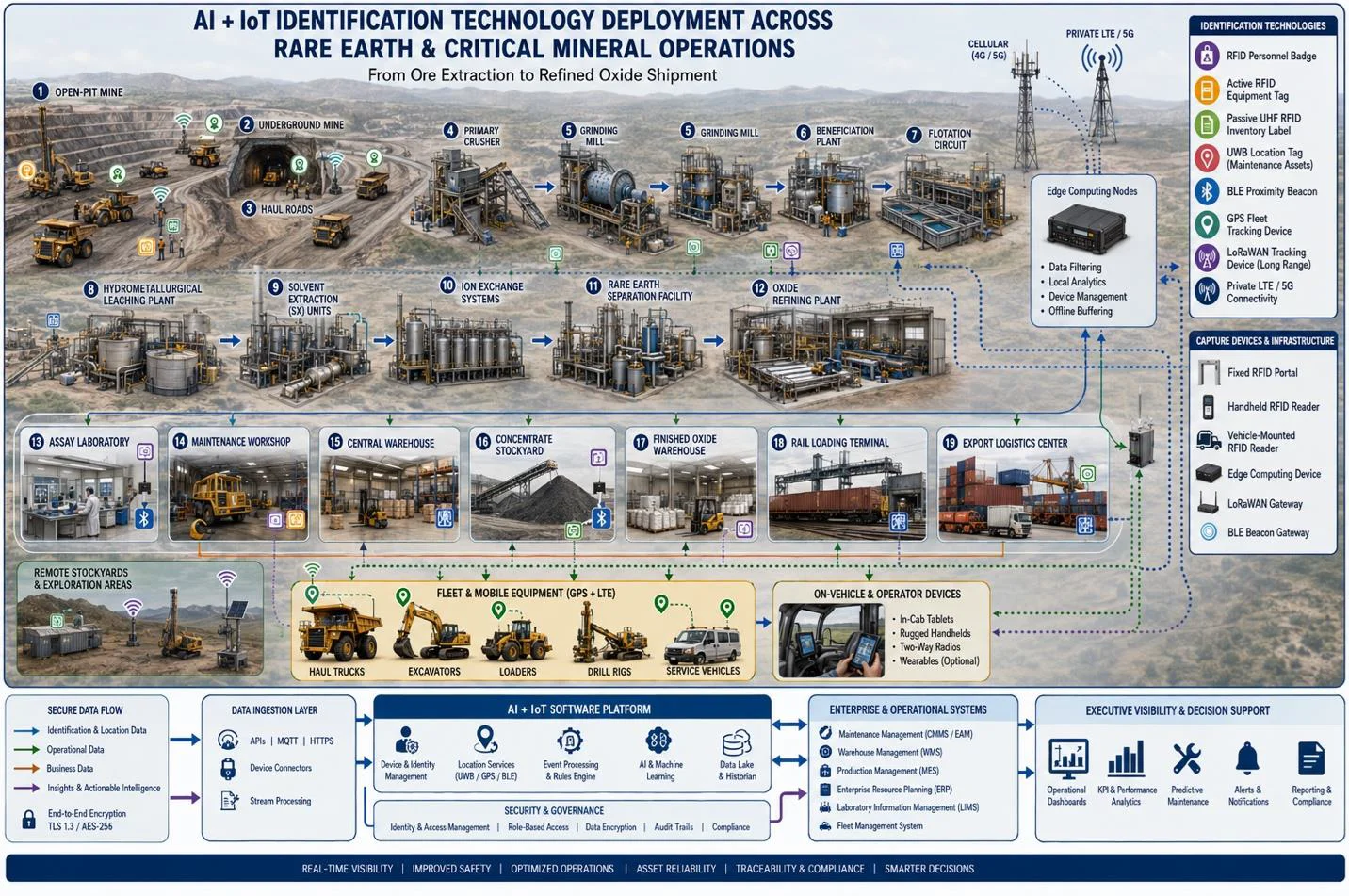
AI + IoT Identification Technology Deployment Across Rare Earth and Critical Mineral Operations
This engineering illustration demonstrates how RFID, UWB, BLE, GPS, LoRaWAN, and private LTE/5G technologies are deployed throughout the complete rare earth and critical mineral value chain, from ore extraction to refined oxide export. It shows how identification devices, edge computing, and AI-powered software securely collect and synchronize operational data with maintenance, warehouse, production, ERP, and executive reporting systems. The visual highlights end-to-end asset visibility, workforce safety, material traceability, predictive maintenance, and real-time operational intelligence across mining and mineral processing operations.
Location Tracking Devices
Reliable AI and IoT deployments begin with selecting identification hardware that matches the physical operating environment and business objectives. Rare earth and critical mineral facilities span extensive open-pit mines, underground workings, beneficiation plants, solvent extraction circuits, oxide refining facilities, maintenance workshops, warehouses, stockyards, and transportation networks. Each environment presents unique operational constraints, requiring different identification technologies to achieve dependable performance.
AI and RFID Tracking
Radio Frequency Identification (RFID) forms the foundation of most AI and IoT identification solutions deployed throughout rare earth and critical mineral operations. From ore extraction through beneficiation, hydrometallurgical processing, solvent extraction (SX), ion exchange, rare earth separation, oxide production, warehousing, and export logistics, RFID delivers dependable identification with high read accuracy while minimizing manual data collection.
Unlike barcode systems that require direct line of sight and operator interaction, RFID automatically captures identification events as personnel, vehicles, equipment, pallets, containers, and materials move through operational checkpoints. AI software correlates these identification records with production schedules, maintenance activities, workforce assignments, inventory transactions, and logistics workflows to generate operational insights that support informed decision-making.
AI and BLE Tracking
Bluetooth Low Energy (BLE) complements RFID by providing continuous proximity awareness within processing facilities, maintenance workshops, warehouses, laboratories, administration buildings, and other indoor operational environments. BLE devices are particularly valuable where frequent location updates and zone-based identification improve workforce coordination and operational efficiency.
AI and UWB Tracking
Ultra-Wideband (UWB) provides highly accurate real-time positioning, often achieving location precision measured in centimeters rather than meters. This level of accuracy makes UWB particularly valuable in complex processing environments where precise personnel and asset location is essential.
AI and GPS Tracking
Global Positioning System (GPS) technology is the primary location technology for mobile equipment operating across large open-pit rare earth mines, exploration leases, waste rock facilities, haul roads, concentrate transportation routes, and geographically dispersed mining concessions. Because satellite positioning does not require dense local infrastructure, GPS provides dependable wide-area visibility for vehicles and mobile assets operating over hundreds of square kilometers.
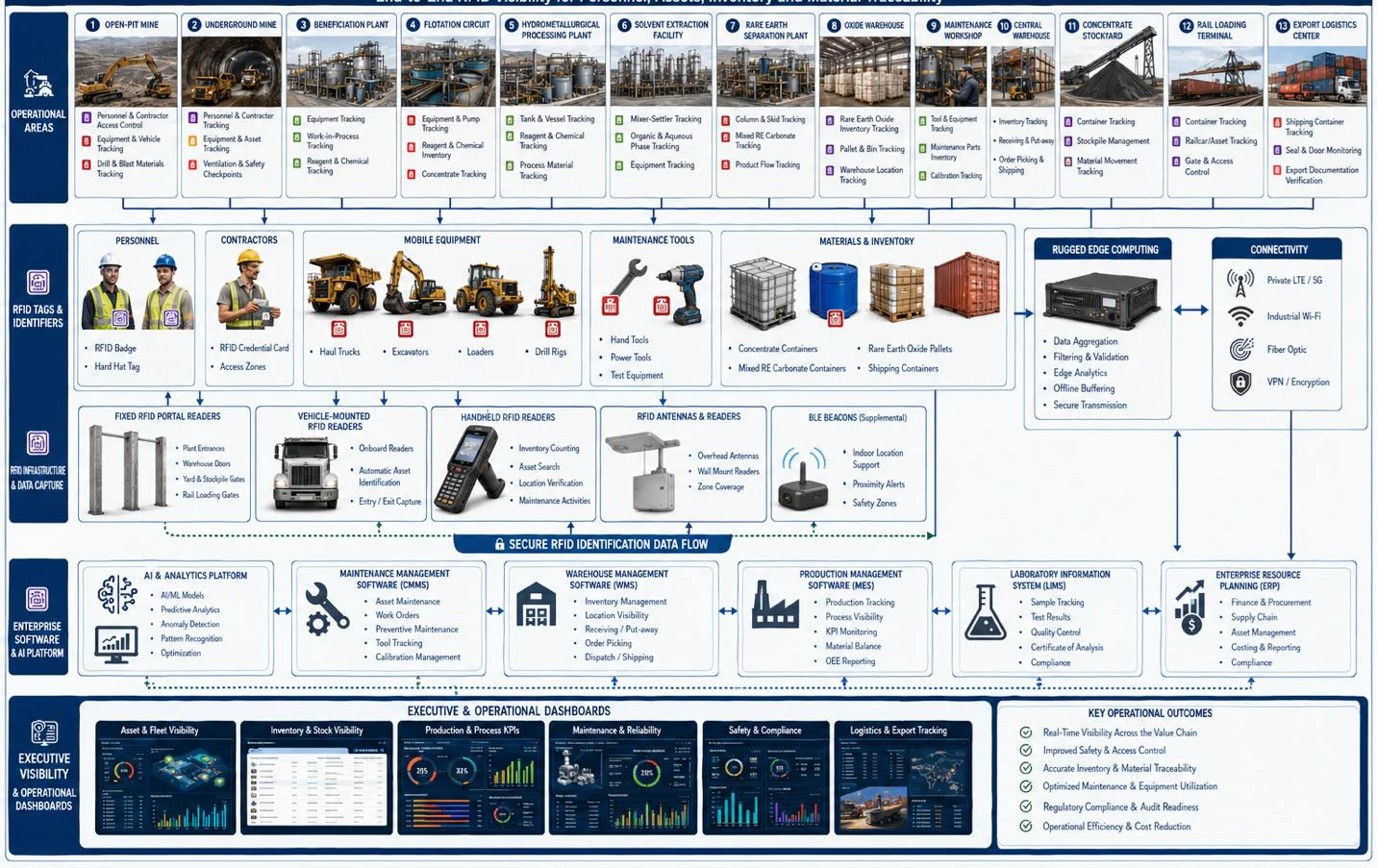
Enterprise AI-Enabled RFID Deployment Architecture for Rare Earth and Critical Mineral Operations
This enterprise block diagram illustrates how AI-enabled RFID technology supports personnel identification, equipment tracking, warehouse inventory management, and material traceability throughout rare earth and critical mineral mining and processing operations. It shows RFID data flowing securely through edge computing into AI analytics, maintenance, warehouse, production, laboratory, and ERP systems, providing real-time visibility, operational intelligence, regulatory compliance, and executive decision support across the entire mining value chain.
AI and LoRaWAN Tracking
LoRaWAN is well suited for identification applications requiring long-range wireless communication with low power consumption across extensive mining properties. Rare earth mining companies frequently operate remote exploration areas, concentrate stockyards, waste rock facilities, field warehouses, contractor compounds, and maintenance staging areas where installing dense wireless infrastructure is impractical.
AI and Cellular Tracking
Cellular communication technologies, including 4G LTE, LTE-M, NB-IoT, private LTE, and private 5G, provide dependable wide-area connectivity for mobile assets traveling between mines, processing facilities, warehouses, rail terminals, ports, and corporate operations. Modern mining companies increasingly deploy private cellular networks to improve communication reliability, operational security, and local coverage within large industrial sites.
Cloud-Based and On-Premises AI and IoT Software Deployment
The deployment of AI and IoT software in rare earth and critical mineral operations depends on operational objectives, cybersecurity requirements, regulatory obligations, and the geographical distribution of mining and processing facilities. Organizations producing strategic minerals often operate across multiple sites, including mines, concentrators, hydrometallurgical plants, separation facilities, refineries, warehouses, and export terminals.
Many large rare earth producers adopt a hybrid deployment architecture, combining cloud platforms for enterprise reporting, supply chain coordination, predictive analytics, and multi-site asset management with on-premises systems for real-time process control, industrial automation, secure identification, and mission-critical operational functions.
Standards, Regulations, and Industry Frameworks
Rare earth operations deploying AI and IoT solutions typically align with a combination of mining safety regulations, industrial cybersecurity standards, wireless communication standards, and supply chain traceability requirements.
Leading Technology Providers for AI and IoT Solutions
The market spans industrial identification hardware, enterprise location software, wireless communications, rugged mobile computing, cybersecurity, and industrial systems integration.
Case Studies
Mountain Pass, California, USA
Case Study: AI and IoT Workforce Location and Secure Access Management for a Rare Earth Mining and Processing Operation
Background
A large rare earth mining and mineral processing operation in Mountain Pass, California required greater operational visibility across its open-pit mine, primary crushing facilities, beneficiation plant, concentrate handling areas, maintenance workshops, warehouse buildings, solvent extraction operations, oxide production areas, and administrative facilities. The organization sought to strengthen workforce accountability, improve controlled-area access verification, and reduce the time required to locate personnel and critical operational assets while maintaining uninterrupted production.
Problem
The mining operation encountered several operational challenges:
- Manual personnel check-in and check-out procedures delayed workforce accountability.
- Restricted process areas required stronger access verification.
- Maintenance personnel spent significant time locating specialized tools.
- Warehouse staff relied on manual inventory reconciliation.
- Mobile equipment assignments were difficult to verify across multiple production areas.
- Historical movement records for contractors and visitors were incomplete.
Solution
RareMetal AI collaborated with engineering teams from GAO, GAO Tek Inc., and GAO RFID Inc. to implement an enterprise solution:
- UHF RFID personnel identification badges and fixed readers at entry points.
- Handheld UHF RFID readers supporting inventory audits.
- BLE gateways and beacons for indoor workforce location and proximity verification.
- UWB location tags deployed within maintenance workshops.
- GPS tracking devices installed on haul trucks and mobile maintenance units.
- Rugged edge computing equipment supporting local processing.
AI software correlated identification records with ERP, CMMS, WMS, and production reporting systems to support operational decision-making.
GAO Hardware Utilized
- UHF RFID Readers, Tags, Antennas, and Accessories
- BLE Gateways, Beacons, and Accessories
- GPS IoT Tracking Devices and Accessories
- Device Edge Computing Systems
Result
Reduced average personnel accountability verification time by approximately 65% during emergency mustering exercises. Improved warehouse inventory reconciliation efficiency, faster maintenance tool retrieval, better compliance documentation, and enhanced workforce deployment visibility.
Lesson Learned
Combining RFID, BLE, GPS, and UWB technologies produced significantly greater operational value than relying on a single wireless method. Selecting technologies according to operational environment simplified future expansion while maintaining reliable performance.
Elko, Nevada, USA
Case Study: AI and IoT Asset Identification and Inventory Management Across Rare Earth Processing Facilities
Background
A rare earth processing and refining operation located near Elko, Nevada required greater visibility of processing equipment, warehouse inventory, maintenance assets, reagent storage, packaged rare earth products, and logistics activities supporting downstream production. The organization planned to modernize asset identification while reducing manual inventory reconciliation and strengthening digital chain-of-custody documentation.
Problem
The processing operation experienced several recurring issues:
- Equipment location records depended on manual updates.
- Warehouse inventory counts required extensive labor and production downtime.
- Concentrate containers required stronger identification throughout internal logistics.
- Mobile maintenance assets were difficult to locate across multiple buildings.
- Asset utilization reports required significant manual reconciliation.
Solution
RareMetal AI, supported by GAO, GAO Tek Inc., and GAO RFID Inc., deployed an enterprise solution emphasizing asset visibility and inventory control:
- Passive UHF RFID tags attached to maintenance equipment, inventory, and concentrate containers.
- Fixed RFID portals at warehouse entrances and transfer points.
- LoRaWAN gateways providing long-range communication for remote storage areas.
- BLE beacons supporting maintenance workshop equipment identification.
- GPS IoT tracking devices installed on logistics vehicles.
The deployment integrated with existing software scheduling systems and executive reporting dashboards to create a unified operational record.
GAO Hardware Utilized
- UHF RFID Readers, Tags, Modules, and Antennas
- BLE Gateways and Products
- LoRaWAN Gateways and End Devices
- GPS IoT Tracking Devices
- Data Centre & Device Edge Computing Systems
Result
Observed approximately 52% reduction in manual inventory reconciliation effort during scheduled audits. Improved identification accuracy for maintenance assets, faster verification of oxide product movements, and better equipment utilization reporting through automated records.
Lesson Learned
Large processing facilities benefit from combining RFID for high-volume identification with LoRaWAN for distributed outdoor assets and BLE for indoor equipment visibility, providing dependable operational records while reducing manual administration.
Salt Lake City, Utah, USA
Case Study: AI and IoT Personnel Accountability, Controlled Access, and Mobile Equipment Visibility for a Rare Earth Separation Operation
Background
A rare earth separation and refining operation supporting the production of high-purity rare earth oxides sought to improve personnel accountability, strengthen secure access verification, enhance equipment visibility, and improve inventory reconciliation. The facility required a solution capable of supporting continuous visibility without disrupting production activities.
Problem
Operational reviews identified several opportunities for improvement:
- Personnel accountability during shift changes depended on manual verification.
- Entry into solvent extraction and laboratory areas required stronger controls.
- Mobile maintenance equipment relocated between workshops without automated records.
- Warehouse personnel performed labor-intensive inventory reconciliation.
- Equipment utilization reporting relied on manually consolidated records.
Solution
RareMetal AI implemented an integrated solution combining RFID, BLE, GPS, LoRaWAN, and edge computing technologies:
- UHF RFID personnel identification badges and HF RFID credential cards.
- Fixed RFID portals at production transfer points and maintenance workshops.
- BLE gateways and beacons for indoor workforce location awareness.
- GPS IoT tracking devices on service trucks and warehouse vehicles.
- LoRaWAN gateways for remote storage assets.
AI software correlated identification events with work assignments, shift schedules, and maintenance work orders to optimize resource allocation.
GAO Hardware Utilized
- UHF/HF Readers, Tags, Antennas, and Peripherals
- BLE Gateways, Products, and Accessories
- GPS IoT Trackers and LoRaWAN Devices
- Device & Data Centre Edge Computing Systems
Result
Achieved approximately 61% reduction in emergency mustering verification time. Improved access authorization compliance, faster identification of mobile maintenance equipment, reduced manual warehouse reconciliation activities, and better traceability of packaged rare earth oxides.
Lesson Learned
Separation and refining operations achieve greater value by integrating RFID, BLE, GPS, and LoRaWAN within a unified AI and IoT software environment, simplifying future expansion and eliminating reliance on siloed identification systems.
Saskatoon, Saskatchewan, Canada
Case Study: AI and IoT Workforce Visibility, Secure Access Control, and Material Traceability for a Rare Earth Processing Operation
Background
A rare earth processing and refining operation required improved operational visibility across concentrate receiving facilities, SX circuits, ion exchange operations, calcination facilities, and outbound logistics areas. Operational leadership wanted a scalable solution that could expand as production capacity increased.
Problem
The operation experienced challenges limiting efficiency:
- Personnel accountability relied heavily on manual verification.
- Entry into controlled processing areas required stronger automated verification.
- Maintenance teams spent considerable time locating specialized tools.
- Inventory reconciliation required extensive manual verification.
- Internal transfers between stages generated fragmented documentation.
Solution
RareMetal AI implemented a comprehensive identification solution:
- UHF RFID badges and HF RFID credential cards for restricted areas.
- Fixed UHF RFID readers at transfer points and packaging areas.
- BLE gateways and beacons for proximity-based operational visibility.
- GPS IoT tracking devices installed on service trucks and logistics vehicles.
- LoRaWAN gateways supporting long-range communication.
The AI software integrated with ERP, WMS, CMMS, and LIMS software to maintain a consistent operational record.
GAO Hardware Utilized
- UHF/HF Readers, Tags, Antennas, and Modules
- BLE Gateways, Products, and Accessories
- LoRaWAN Gateways and End Devices
- GPS IoT Trackers and Accessories
- Edge Computing Systems
Result
Achieved a 58% reduction in warehouse inventory reconciliation time. Improved workforce accountability, enhanced controlled-area security, faster identification of mobile maintenance equipment, and better documentation supporting chain-of-custody verification for packaged oxide products.
Lesson Learned
Rare earth processing facilities achieve maximum operational value by deploying complementary wireless technologies based on the specific operating environment. Integrating these through enterprise AI simplifies reporting and strengthens workforce accountability.
Transform Rare Earth & Critical Mineral Operations with Enterprise AI and IoT Identification Solutions
Reliable identification is the foundation of digital mining operations. RareMetal AI helps organizations deploy RFID, UWB, BLE, GPS, LoRaWAN, private LTE, private 5G, and cellular technologies that improve personnel accountability, secure access control, equipment utilization, warehouse operations, concentrate inventory management, and chain of custody throughout the complete rare earth and critical mineral value chain.
Contact our engineering team to discuss an AI and IoT identification solution tailored to your mining operation, processing facility, or multi-site enterprise.
Contact Us