
A Technical Knowledge Center for AI and IoT in Rare Earth & Critical Mineral Operations
Rare earth elements and critical minerals have become strategically significant raw materials supporting electric vehicles, permanent magnet manufacturing, battery technologies, wind turbines, advanced electronics, semiconductor fabrication, aerospace systems, defense equipment, robotics, industrial automation, telecommunications infrastructure, and clean energy technologies. Growing global demand for neodymium, praseodymium, dysprosium, terbium, scandium, yttrium, lithium, graphite, cobalt, nickel, and other strategic minerals has increased the need for mining organizations to improve operational visibility, workforce accountability, equipment utilization, inventory accuracy, and material provenance throughout extraction and processing operations.
Unlike conventional bulk mining operations, rare earth production typically involves complex workflows including geological exploration, drill core management, bulk sampling, blasting, ore hauling, primary crushing, secondary crushing, grinding, beneficiation, froth flotation, acid or alkaline leaching, solvent extraction, ion exchange, precipitation, calcination, oxide production, concentrate storage, quality verification, packaging, and export logistics. Every stage depends on reliable identification and location information to maintain production continuity, operational safety, inventory accuracy, and documented chain of custody.
AI and IoT combines AI with connected identification devices, industrial communication networks, edge computing, and enterprise software to transform identification events into operational insights. Rather than focusing on sensing and monitoring technologies, AI and IoT deployments described throughout this knowledge center emphasize workforce identification, credential verification, equipment location, warehouse inventory management, ore stockpile reconciliation, and strategic mineral traceability.
Technologies commonly deployed across rare earth operations include RFID, Bluetooth Low Energy (BLE), Ultra-Wideband (UWB), Global Positioning System (GPS), LoRaWAN, industrial Wi-Fi, Private LTE, and Private 5G. These technologies exchange identification data with edge computing systems and enterprise software to support personnel accountability, mobile equipment visibility, inventory reconciliation, maintenance planning, and production documentation.
This resource center has been developed specifically for mining engineers, metallurgical engineers, industrial automation specialists, mine planners, reliability engineers, industrial IT professionals, operational technology teams, EPC contractors, system integrators, maintenance managers, warehouse supervisors, and project leaders responsible for deploying AI and IoT identification and location solutions within rare earth and critical mineral operations.
Rather than presenting product marketing information, this knowledge center delivers practical engineering guidance, deployment methodologies, implementation references, technology selection recommendations, and operational best practices that support every stage of an AI and IoT project lifecycle.
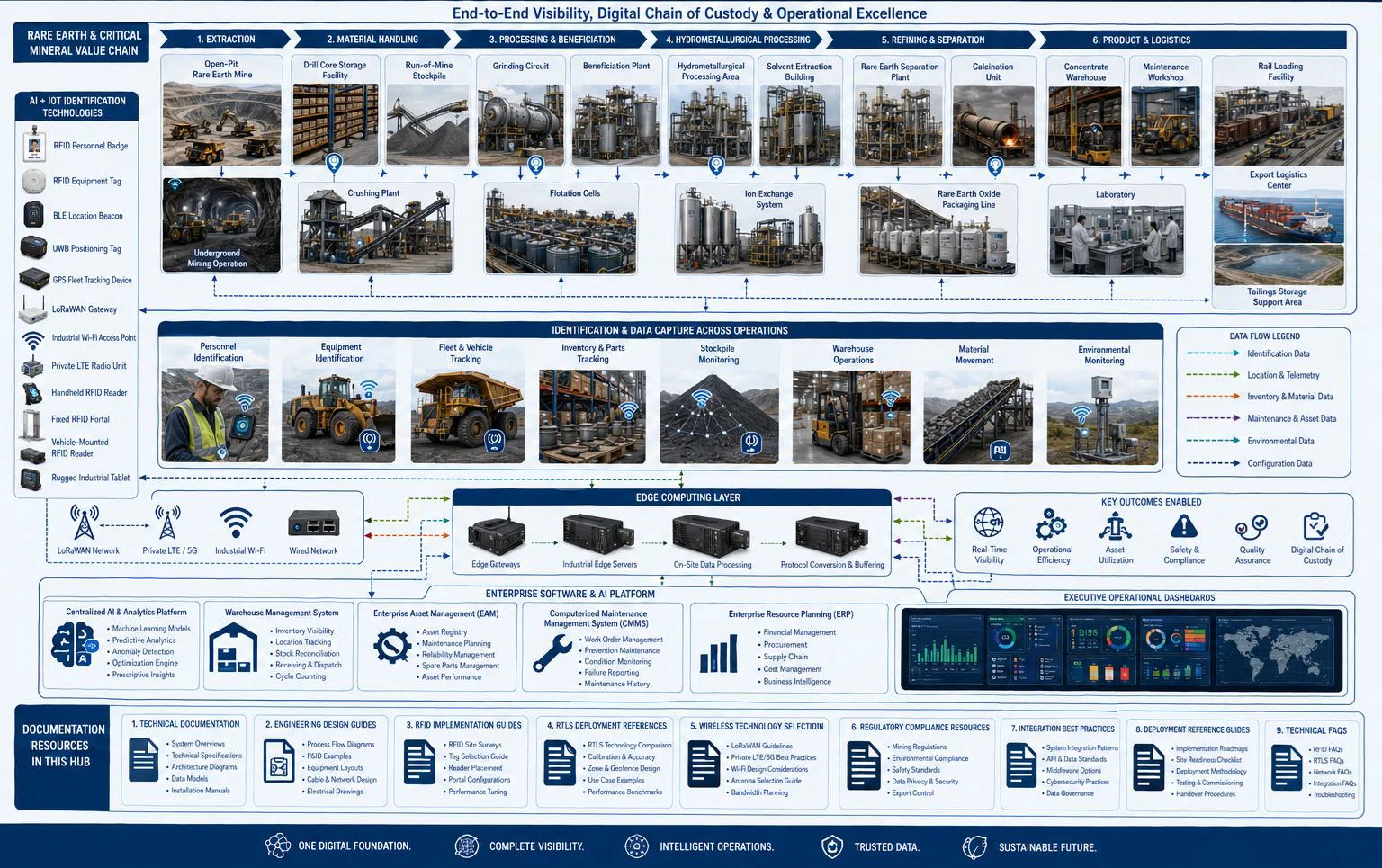
AI + IoT Rare Earth and Critical Mineral Operations Knowledge Map for End-to-End Digital Mining and Material Traceability
This enterprise knowledge map illustrates how AI and IoT technologies support the complete rare earth and critical mineral value chain, from extraction and beneficiation through refining, warehousing, and export logistics. It integrates workforce identification, equipment tracking, inventory visibility, edge computing, enterprise software, and executive dashboards while highlighting the technical documentation resources available for planning, deployment, integration, and compliance.
Who Should Use This Resources
This technical knowledge center has been prepared for professionals involved in engineering, deploying, integrating, operating, and maintaining AI and IoT identification and location systems throughout rare earth and critical mineral operations.
Primary audiences include:
- Mine managers
- Mine planning engineers
- Mining engineers
- Mineral processing engineers
- Metallurgical engineers
- Reliability engineers
- Asset management professionals
- Maintenance managers
- Industrial automation engineers
- Industrial IT teams
- Operational technology specialists
- Digital mine transformation leaders
- EPC contractors
- RFID system integrators
- RTLS implementation specialists
- Warehouse operations managers
- Materials management professionals
- Inventory control teams
- Supply chain managers
- Security managers
- Environmental compliance teams
- Health and safety professionals
- Operational excellence managers
- Process improvement teams
- Laboratory managers
- Project engineering organizations
Each section uses terminology commonly encountered within rare earth extraction, critical mineral beneficiation, solvent extraction, hydrometallurgical processing, rare earth separation, oxide refining, stockpile management, strategic mineral logistics, and industrial identification projects to ensure technical relevance for engineering and operational audiences.
Resources Available Within This Engineering Knowledge Center
This engineering knowledge center consolidates practical guidance for designing, deploying, integrating, operating, maintaining, and expanding AI and IoT identification and location solutions across rare earth and critical mineral operations. Resources have been organized to support the complete project lifecycle, beginning with feasibility studies and engineering assessments, continuing through wireless technology selection, detailed design, procurement, installation, software integration, commissioning, operator training, operational validation, lifecycle maintenance, and future system expansion.
Technical references emphasize identification and location technologies rather than sensing solutions, reflecting the operational priorities of rare earth mining organizations. Readers will find engineering guidance covering personnel location analytics, credential verification, mobile equipment identification, stockpile inventory reconciliation, warehouse inventory management, material provenance, digital chain of custody, software interoperability, industrial cybersecurity considerations, communication network planning, redundancy strategies, edge computing deployment, and long-term lifecycle management.
By combining engineering best practices with domain-specific operational guidance, this Resources Hub helps mining organizations reduce implementation risk, improve project planning, standardize deployment methodologies, strengthen operational documentation, and establish scalable AI and IoT identification systems capable of supporting future expansion across geographically distributed rare earth and critical mineral operations.
Rare Earth Technical Documentation
Comprehensive engineering documentation is one of the most important success factors for AI and IoT deployments within rare earth and critical mineral operations. Whether the project involves workforce location, credential verification, equipment identification, inventory reconciliation, or material provenance, standardized documentation improves deployment quality, simplifies maintenance, reduces implementation risk, and supports long-term operational reliability.
Rare earth mining projects typically span geographically dispersed open-pit mines, underground workings, beneficiation plants, hydrometallurgical facilities, solvent extraction (SX) circuits, ion exchange systems, calcination units, rare earth oxide packaging lines, concentrate warehouses, laboratories, maintenance workshops, rail terminals, and export logistics centers. Every operational area has unique identification requirements that should be documented before implementation begins.
Rather than treating documentation as a project deliverable completed after installation, engineering organizations should develop and maintain documentation throughout the complete AI and IoT system lifecycle, including planning, detailed engineering, procurement, commissioning, operations, maintenance, upgrades, and future expansion.
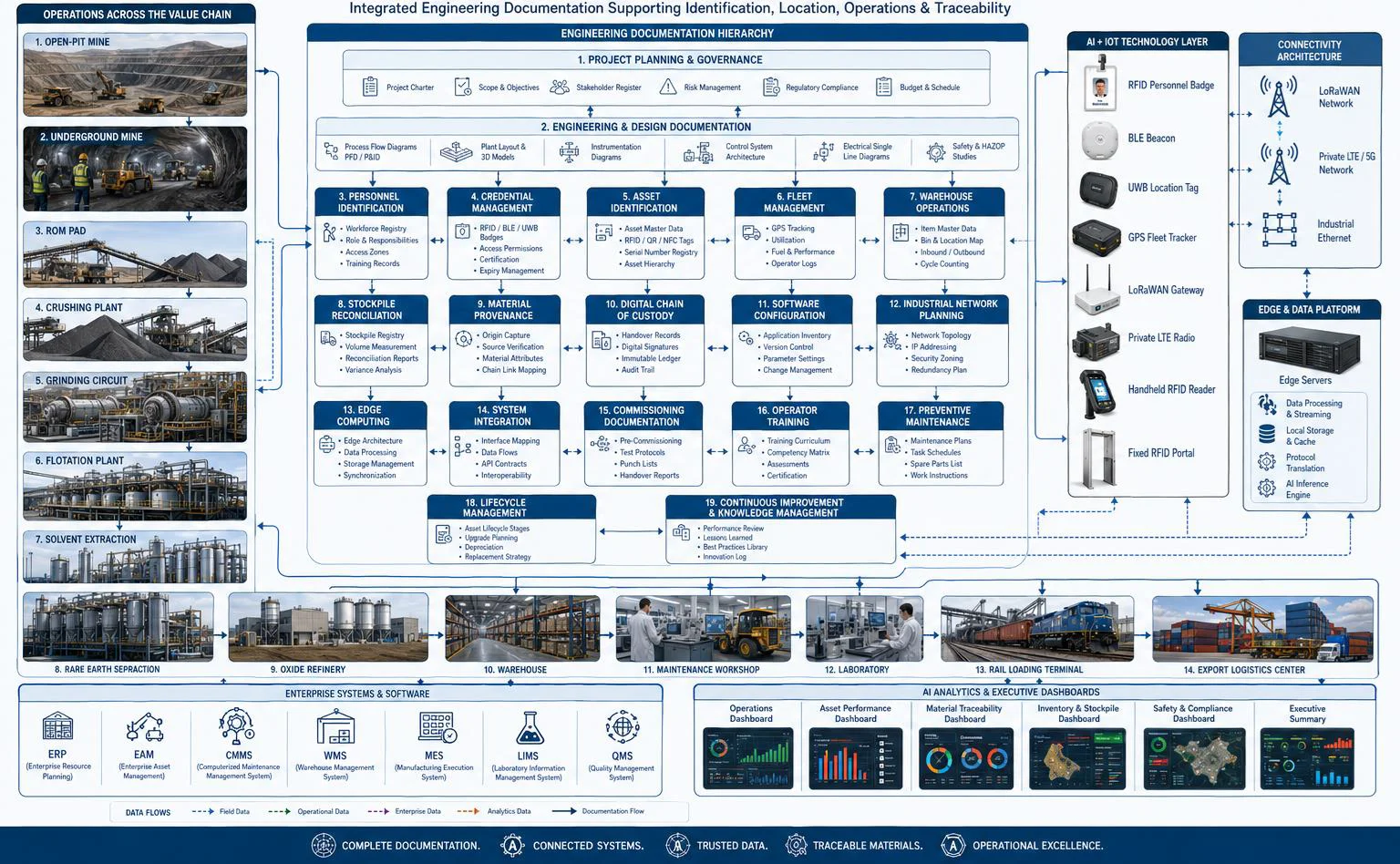
AI + IoT Engineering Documentation Framework for Rare Earth and Critical Mineral Operations
This engineering framework diagram illustrates the complete documentation hierarchy supporting AI and IoT deployment across rare earth and critical mineral operations. It connects project planning, engineering design, workforce identification, asset management, material provenance, digital chain of custody, industrial networking, enterprise software, and lifecycle maintenance with mining, processing, refining, warehousing, and export facilities.
Engineering Best Practices for AI and IoT Identification Projects
Successful AI and IoT identification projects begin with a comprehensive operational assessment rather than immediate hardware selection. Engineering teams should first document workforce movement patterns, equipment utilization, maintenance workflows, warehouse processes, ore movement, concentrate handling, security policies, and software integration requirements. This assessment establishes a baseline for selecting the most appropriate identification technologies and deployment strategy.
Standardized identification conventions are equally important. Personnel, contractors, mobile equipment, processing assets, warehouse locations, stockpiles, laboratory samples, and material batches should follow consistent naming and coding structures throughout the organization. Standardization simplifies software integration, reporting, inventory reconciliation, maintenance planning, and enterprise analytics while reducing administrative errors.
Wireless communication planning should account for the diverse operating environments found across rare earth facilities. RFID portals are well suited for controlled identification points such as warehouse entrances, processing line transitions, and access checkpoints. BLE provides cost-effective indoor location awareness for personnel and mobile assets, while UWB supports high-precision positioning in maintenance workshops, separation plants, and packaging facilities. GPS remains the preferred solution for outdoor fleet operations, whereas LoRaWAN and Private LTE enable reliable communication across expansive mine sites and remote infrastructure.
Engineering teams should also design for resilience by incorporating communication redundancy, edge computing for local processing, secure authentication, role-based access control, encrypted data transmission, scheduled backups, and documented disaster recovery procedures. Pilot deployments in representative production areas—such as a ROM stockpile, solvent extraction building, maintenance workshop, or warehouse—allow organizations to validate identification accuracy, communication coverage, software integration, and operational workflows before expanding to full-scale implementation.
Finally, comprehensive documentation should be maintained throughout the system lifecycle. Engineering drawings, configuration records, commissioning reports, maintenance histories, software version control, user training materials, and change management documentation provide the foundation for reliable long-term operation, future upgrades, and scalable expansion across multiple rare earth and critical mineral facilities.
Rare Earth Regulatory Compliance Resources
Rare earth and critical mineral operations function within highly regulated industrial environments where workforce safety, operational accountability, environmental stewardship, strategic material security, export controls, and production documentation are fundamental operational requirements. AI and IoT identification and location solutions support compliance programs by providing reliable digital records for personnel identification, access authorization, equipment accountability, inventory reconciliation, material provenance, and chain of custody throughout mining, mineral processing, refining, storage, and logistics operations.
Although regulatory requirements differ between jurisdictions, engineering organizations generally benefit from maintaining standardized digital documentation that supports internal governance, customer audits, quality assurance programs, environmental management systems, and operational reporting. This section provides technical references that help engineering teams incorporate AI and IoT identification systems into compliance programs while maintaining operational efficiency.
Critical Mineral Technical Specification Guides
Selecting the appropriate identification technology requires evaluating operational objectives, environmental conditions, facility layout, positioning accuracy, communication range, infrastructure availability, and software integration requirements. Rare earth and critical mineral operations often employ multiple wireless technologies because no single solution satisfies every operational requirement across extraction, processing, warehousing, maintenance, and logistics environments.
Strategic Mining Deployment Reference Guides
Every rare earth and critical mineral operation presents unique engineering challenges related to geology, infrastructure, production methods, workforce size, and operational workflows. These deployment reference guides consolidate practical implementation recommendations derived from real-world industrial identification projects to help engineering teams reduce project risk and improve deployment consistency.
Reference guides are organized around major operational environments, including:
- Geological exploration facilities
- Drill core storage buildings
- Open-pit rare earth mines
- Underground critical mineral mines
- Run-of-mine stockpiles
- Crushing and grinding circuits
- Beneficiation plants
- Froth flotation operations
- Hydrometallurgical processing facilities
- Solvent extraction plants
- Ion exchange systems
- Rare earth separation facilities
- Calcination units
- Rare earth oxide packaging operations
- Maintenance workshops
- Central warehouses
- Laboratory facilities
- Rail loading terminals
- Export logistics centers
- Tailings storage support facilities
Each deployment guide provides recommended identification workflows, installation practices, wireless communication recommendations, software integration guidance, commissioning procedures, operator training considerations, maintenance planning, and lifecycle management strategies.
Critical Mineral Frequently Asked Questions
AI of Things (AIoT), commonly referred to as AI and IoT, combines AI with connected identification devices, industrial communication technologies, edge computing, and enterprise software to improve operational visibility and decision-making. Within rare earth and critical mineral operations, AI and IoT primarily focuses on identification and location solutions rather than sensing technologies.
Typical applications include workforce location, personnel credential verification, equipment identification, fleet location, warehouse inventory reconciliation, ore stockpile management, concentrate tracking, and digital chain of custody throughout beneficiation, hydrometallurgical processing, solvent extraction, ion exchange, rare earth separation, oxide refining, packaging, warehousing, and logistics.
AI analyzes identification events generated by RFID, BLE, UWB, GPS, LoRaWAN, Private LTE, and Private 5G systems to identify operational trends, improve resource utilization, detect unusual movement patterns, optimize equipment allocation, and support production planning.
Different operational environments require different wireless identification technologies. Most enterprise deployments combine several technologies because each provides unique advantages. Common technologies include:
- RFID for personnel credentials, warehouse inventory, maintenance tools, packaged rare earth oxides, spare parts, shipping containers, and controlled identification checkpoints.
- Bluetooth Low Energy (BLE) for indoor workforce location awareness, contractor accountability, warehouse personnel tracking, and proximity-based operational workflows.
- Ultra-Wideband (UWB) for high-precision positioning of personnel and high-value equipment in processing plants, maintenance workshops, and separation facilities.
- GPS for outdoor fleet management, haul truck location, contractor vehicles, exploration fleets, and service equipment.
- LoRaWAN for long-range identification across remote mine infrastructure, stockyards, and geographically distributed facilities.
- Private LTE and Private 5G for secure, reliable industrial communications supporting multi-site mining operations and remote production facilities.
Technology selection should be based on operational workflows, positioning accuracy requirements, communication range, environmental conditions, infrastructure availability, and integration objectives rather than selecting a single technology for all applications.
AI and IoT identification systems improve workforce accountability by maintaining accurate digital records of personnel locations, authorized access, contractor activity, and workforce movement throughout operational facilities.
These systems support:
- Shift check-in verification
- Contractor accountability & Visitor management
- Restricted-area & Hazardous processing authorization
- Lone worker & Refuge chamber accountability
- Emergency evacuation & Muster point reconciliation
- Incident investigation & Workforce reporting
AI-assisted analytics can identify recurring movement patterns, unauthorized access attempts, congestion around processing areas, or operational bottlenecks that may warrant additional review by safety managers or operational leadership.
Yes. Inventory reconciliation is one of the most valuable applications of AI and IoT identification systems throughout rare earth operations.
Organizations commonly identify and reconcile:
- Run-of-mine ore & ROM stockpiles
- Concentrate stockpiles
- Mixed rare earth carbonate (MREC)
- Intermediate processing batches & Rare earth oxides
- Packaging materials & Warehouse inventory
- Spare parts & Maintenance tools
- Laboratory samples
- Shipping containers & Export cargo
Automated identification significantly reduces manual inventory counting while improving inventory accuracy, warehouse efficiency, production reporting, and operational planning.
Material provenance is increasingly important throughout strategic mineral supply chains. AI and IoT identification systems help establish digital documentation for:
- Geological samples & Drill core identification
- Ore source verification & Mine block identification
- Beneficiation campaigns
- Hydrometallurgical processing
- Solvent extraction campaigns & Ion exchange batch documentation
- Rare earth separation batches & Calcination batches
- Oxide packaging & Warehouse transfers
- Export documentation & Customer deliveries
These records support production genealogy, inventory reconciliation, customer quality documentation, internal audits, and operational transparency throughout the rare earth value chain.
Yes. Enterprise AI and IoT solutions are designed to exchange identification information with existing industrial business systems rather than replacing them.
Typical integrations include:
- Enterprise Resource Planning (ERP)
- Enterprise Asset Management (EAM)
- Computerized Maintenance Management Systems (CMMS)
- Warehouse Management Systems (WMS)
- Laboratory Information Management Systems (LIMS)
- Manufacturing Execution Systems (MES)
- Fleet & Mine planning software
- Workforce & Identity management systems
- Corporate reporting & BI software
Standards-based integration simplifies data exchange while preserving existing operational workflows and software investments.
Both deployment models provide significant operational value, and the appropriate choice depends on organizational requirements.
Cloud deployments are often preferred for organizations operating multiple mines, processing plants, warehouses, and logistics facilities because they simplify centralized administration, software updates, scalability, and enterprise reporting.
Server deployments are frequently selected where local operational control, sovereign data requirements, isolated mining locations, or highly secure environments require on-premises infrastructure.
Many organizations also adopt hybrid deployment strategies that combine local edge computing with centralized cloud reporting to balance operational performance and enterprise visibility.
Why Engineering Organizations Choose RareMetal AI
RareMetal AI specializes in AI and IoT identification and location solutions developed specifically for the operational requirements of the Mining & Resources Industry, with a strong focus on rare earth and critical mineral operations. Our engineering methodologies emphasize practical implementation, standards-based integration, lifecycle maintainability, and measurable operational improvements across exploration support, mining, mineral processing, refining, warehousing, maintenance, and logistics.
RareMetal AI was created within Aperture Venture Studio, with support from GAO, drawing upon more than two decades of industrial IoT experience. Thousands of successful IoT deployments across industrial sectors have contributed to implementation methodologies that prioritize engineering rigor, operational reliability, and scalable system design.
Significant investment in research and development, supported by comprehensive quality assurance processes, enables RareMetal AI to continuously refine identification technologies, deployment practices, and enterprise software integration methods. Technical support is available through experienced specialists providing both remote and on-site implementation assistance.
The organization is led by Ph.D. professionals from leading universities and has established relationships with industry experts and strategic partners. Over the years, the broader organization has supported numerous Fortune 500 enterprises, advanced research institutions, prestigious universities, and government agencies throughout the United States and Canada. These real-world engagements contribute practical engineering knowledge reflected throughout this AI and IoT Resources Hub.
Continue Exploring the Rare Earth & Critical Minerals Knowledge Center
This Resources Hub is part of a comprehensive technical library covering AI and IoT identification and location solutions throughout the rare earth and critical mineral lifecycle.
Additional resources include:
- Personnel location analytics
- Workforce movement analysis
- Site access verification
- Credential management
- Restricted-area authorization
- Equipment location analytics
- Fleet identification
- Asset lifecycle management
- Warehouse inventory management
- Ore stockpile reconciliation
- Mixed rare earth carbonate tracking
- Rare earth oxide inventory optimization
- Material provenance
- Digital chain of custody
- RFID implementation guides
- BLE deployment references
- UWB positioning documentation
- GPS fleet management guidance
- LoRaWAN deployment recommendations
- Private LTE implementation guides
- Private 5G planning references
- Middleware integration
- Edge computing deployment
- Cloud implementation guidance
- Server deployment recommendations
- Commissioning procedures
- Preventive maintenance practices
- Lifecycle management documentation
- Engineering design references
- Technical specification guides
- Operational best practices
Collectively, these resources provide engineers, project teams, system integrators, and operational leaders with practical guidance for planning, deploying, operating, and expanding enterprise AI and IoT identification systems.
Building the Digital Foundation for Rare Earth & Critical Mineral Operations
Rare earth and critical minerals are essential to advanced manufacturing, electrification, renewable energy, semiconductor production, aerospace, defense systems, and numerous other strategic industries. As production volumes increase and supply chains become more transparent, mining organizations require dependable methods for identifying personnel, verifying site access, locating mobile assets, reconciling inventories, and documenting material movement throughout the entire mine-to-market lifecycle.
AI and IoT identification technologies, including RFID, RTLS, BLE, UWB, GPS, LoRaWAN, Private LTE, and edge computing, provide the digital foundation for these capabilities. When supported by comprehensive engineering documentation, standards-based software integration, disciplined deployment methodologies, and robust governance practices, these technologies enable organizations to improve workforce safety, optimize equipment utilization, strengthen inventory accuracy, simplify regulatory documentation, and maintain trusted digital chain-of-custody records.
This Rare Earth & Critical Minerals Resources Hub has been developed as a practical engineering reference for technical professionals responsible for designing, implementing, integrating, and maintaining AI and IoT identification systems. By combining detailed technical documentation, deployment guidance, wireless technology recommendations, regulatory resources, implementation best practices, and engineering FAQs, the hub supports informed decision-making across every phase of an AI and IoT project while reinforcing operational excellence throughout the Mining & Resources Industry.
Contact RareMetal AI
Modern rare earth and critical mineral operations demand accurate identification, reliable workforce accountability, efficient equipment management, precise inventory reconciliation, and verifiable material provenance across increasingly complex production environments.
Whether your organization operates open-pit mines, underground mines, beneficiation facilities, solvent extraction plants, rare earth separation facilities, oxide refineries, maintenance workshops, warehouses, laboratories, or export logistics centers, RareMetal AI can help develop an AI and IoT identification strategy aligned with your operational objectives.
Our engineering specialists work closely with mining organizations, EPC contractors, industrial IT teams, operational technology groups, and system integrators to evaluate operational requirements, recommend appropriate RFID, BLE, UWB, GPS, LoRaWAN, and Private LTE technologies, integrate enterprise software, and support successful deployment from initial planning through long-term lifecycle management.
Contact RareMetal AI to discuss your next AI and IoT identification project and discover how enterprise-grade workforce location, asset identification, inventory reconciliation, and material traceability solutions can improve operational visibility across your rare earth and critical mineral operations.
Contact Us